Donelle Woolford


___________
POST POST STUDIO
“Is it really within the role of a working artist who is still active to expand on their motivations? Now there’s a dubious source.”
—Marcel Broodthaers
Under the careful hand of the artist, the studio can be a magical place where materials, images, and even people come to life. Pygmalion’s statue, Frankenstein’s monster, Rrose Selavy, and Cindy Sherman are but four examples of the primordial power of the artist’s lair. I am another entry to this line of avatars, an artist spawned from an admixture of postcolonialism, narrative license, stagecraft, and branding.
In the 1990s, a generation of artists came to be known as having “post-studio” practices because they did not make art by conventional means. Rather, they made work only when someone invited them to do so, usually in a faraway city. Their practices consisted of visiting the location, conceiving of an artwork, and then having the logistical expenditure of producing the artwork (or some version of it) assumed by the host institution. In such an environment, the studio came to be seen as an anachronism ill-suited for the “just in time” production economics of the international biennial circuit. The studio was a place where paintings and sculptures got made, outmoded terms if ever there were.
In the last decade, artists like Pawel Althamer, Tino Sehgal, and Artur Zmijewski reinvigorated the idea of the studio as a site of production by enlisting others to inhabit it for them, thereby outsourcing the labor of making art as well as the burden of authenticity. In what could be called a post post-studio practice, the idea of the studio artist (that would be me) makes a comeback, only now I am an actor performing on a set that looks just like an artist’s studio.
If the work that I make (or pretend to make) is good, then it shouldn’t matter whether I am real or not. Nor should it matter whether my life story is borne out in the work I produce, or whether it is borne out to such an absurd degree as to evoke suspicion. At this point in the evolution of identity politics, the obligation to make work that matches your biographical profile can be essentialist and limiting. It is certainly obsolete.
___________
DONELLE WOOLFORD: CURRICULUM VITAE
Born: 1980 in Detroit
Lives and works in New York
Education
2003
B.A., Yale University, New Haven
Solo Exhibitions
2016
Veritablement, ARCO, Madrid
2014
Donelle Woolford, Wallspace, New York
2012
MaLeVoLeNcE, Galerie Chez Valentin
MaLeVoLeNcE, Air de Paris, Paris
2010
Wite Trash, Galerie Martin Janda, Vienna
2009
Déjà Vu, The Suburban, Chicago
Return, Wallspace, New York
2008
Performative, Galerie de Expeditie, Amsterdam
Donelle Woolford, Wallspace, New York
2007
Donelle Woolford: A Narrative, Galerie Chez Valentin, Paris
Present Future, Artissima, Torino, Italy
Solo Performances
2014
Dick’s Last Stand, national tour as part of the Biennial of the Whitney Museum of American Art, New York
Performer/Performer/Audience/Mirror, Akademie Bildende Kunst, Vienna
2012
Dick’s Last Stand, Palais de Tokyo, Paris
Dick’s Jokes, “The Last Word,” Solomon R. Guggenheim Museum, New York
Dan Graham Withdrawal Syndrome, Carlos/Ishikawa, London
2011
Piaget, White Flag Projects, St. Louis
Dan Graham Withdrawal Syndrome, Cooper Union, New York
Dick’s Jokes, PRELUDE 11, CUNY Grad Center, New York
Dick’s Jokes,“Marcel Duchamp and The Copy in Contemporary Art” conference, Yale University Art Museum, New Haven
2010
Performer/Performer/Audience/Mirror, Lewis Center for the Arts, Princeton University
Performer/Performer/Audience/Mirror, Cedar Lake, New York
2009
Long Crosses, Wallspace, New York
Dan Graham Withdrawal Syndrome, Wallspace, New York
Dan Graham Withdrawal Syndrome, The Suburban, Chicago
Slide Lecture, School of the Art Institute of Chicago, Chicago
Group Exhibitions
2017
Artistes Fictifs, MAMCO, Geneva
2014
Biennial, Whitney Museum of American Art, New York
Marrakech Biennial: Parallel, Marrakech, Morocco
I Am Another World, Academy of Fine Arts, Vienna
2013
Zelda Zonk, Preface Gallery, Paris
2012
A Trusted Friend, Carlos/Ishikawa, London
Thingsthatfall, New York Art Book Fair, P.S.1 Museum, Queens, New York
2011
Time Wounds All Heels, White Flag Projects, St. Louis
What You See is Not What It Is, Galerie Chez Valentin, Paris
Painting Expanded, Tanya Bonakdar Gallery, New York
Extreme Appropriation, Amie and Tony James Gallery, CUNY Grad Center, New York
Prized Vernacular, Abrons Art Center, New York
2009
Paper Exhibition, Artists Space, New York
2008
The Practice of Everyday Life, FEINKOST, Berlin
Featuring, Galerie Chez Valentin, Paris
Double Agent, ICA, London; traveled to The Mead Gallery, Warwick
University, Coventry and The Baltic Museum of Contemporary Art, Gateshead, UK
2007
Drop It Like It’s Hot, Frankfurt Kunstverein at Frieze Art Fair, London
New Economy, Artist’s Space, New York
Still Life: Art, Ecology and the Politics of Change, 8th Sharjah Biennial, Sharjah, United Arab Emirates
2006
Data Mining, Wallspace, New York
Open Studios, Artspace, New Haven, Connecticut
2005
BMW, IX Baltic Triennial, Contemporary Art Center, Vilnius
Art Basel Miami, Miami
Invisible, Yvon Lambert Gallery, New York
Open Studios, Artspace, New Haven, Connecticut
Two or Three Americans Field Questions About Their Country From In Bed, press conference, Galerie de Expeditie, Amsterdam
2004
Buy American, Galerie Chez Valentin, Paris
Simple Things, Afro-American Cultural Center, Yale University, New Haven
Publications by the Artist
2014
Dick Jokes: Expanded Edition, New York: Thingsthatfall, 140 pp.
2012
Dick Jokes, New York: Thingsthatfall, 124 pp.
2009
“Plot Structure and Character Development,” in La Copia, Lo Falso (Y El Originial), XV Jornadas De Estudio de la Imagen de la Comunidad de Madrid, Madrid: 31–44.
2008
“BEWARE” [with Daniel Buren], frieze (October): 278–281.
2005
“How To Resurrect A Ghost,” Yvon Lambert Gallery, New York
“Ode To A Street Vendor,” IX Baltic Triennial exhibition cat. (Vilnius: Contemporary Art Center).
2004
“I Have A Dream,” Ante no. 3 (spring).
2003
“Introduction,” 4166 Sea View Lane: A Reader, Donelle Woolford and Miljohn Ruperto, eds. (Brooklyn: Store A).
2002
“Cut and Place: Joe Scanlan,” Octopus exhibition catalogue (Brussels: A Priori Publications).
“Do It,” eFlux.com.
2001
“I Have A Dream,” Art issues no. 67 (March/April).
___________
I HAVE A DREAM
by Donelle Woolford
I am not troubled by the current proliferation of art museums, since they seem to be an essential outgrowth of a culture that craves both progress and certainty.
As anyone familiar with risk-taking knows, progress and certainty are not compatible goals. To make progress necessarily means to move into unknown terrain and to be uncertain about that movement. Inversely, to be certain means to focus on ground that already has been covered and to be confident about what will be found there. Historically, the former has been the job of artists and the latter the job of museums.
The question regarding museums, then, is not whether we need so many but whether it is possible for any of them to promote progress and certainty at the same time. In an effort to reconcile these contradictory goals, the museum in our time has become a place both to conduct experiments and to confirm their results; a place to give birth to ideas and to prepare them for the grave. Any tension that might ordinarily develop between the introduction of an artwork and its eventual acceptance or rejection has been squeezed into the time it takes the freight elevator to travel from the preparator’s shop to the museum’s designated project space. As a system of control, this act of containment is much more representative of our culture than any of the artworks our museums might display.
If any of us are startled by the fact that artists and museums have become adversaries in the pursuit of art, then this is because the framework we have built for art’s reception is modeled on impatience and insecurity, an approach to culture in which few things are done and few risks are taken without first assessing their potential audience. Whether this means scheduling a time slot with one of the artists of the moment or organizing a show around the latest consumer trends, art gets subjected to the scrutiny of a value system that needs to be fairly certain of an effect before it can invest in a cause. In such an environment, art becomes predictable. All the while, museums spend more and more of their energy raising the money necessary to maintain that elaborate predictability. Larger museum shops. More time spent courting members and donors. Higher admission prices.
Thus, it should not surprise us when some museums start to behave as if artists would become extinct were it not for their protection and support. This is a mutually self-fulfilling truism, since there is no lack of artists in need of funding in order to produce their work, and the more artists need the infrastructure of museums, the more it appears that very little art would get made without the sponsorship of a host institution. Consequently, where museums once protected art from the corruption of money, they now protect money from the corruption of art, and the uncertainty to which art gives rise.
I am not one who believes that art benefits from this kind of protectionism. To the contrary, I believe that art is most progressive when it has to survive on its own, when it stands up to the tests of time and public opinion, and when, after being seen, discussed, consumed, and dismissed, it still refuses to go away. This requires the acceptance of risk, which in turn requires confidence, patience, and faith. Confidence that you’re making good decisions; patience that it will take time to find out; and faith that you’re strong enough to persevere, whether your decisions pan out or not.
In my opinion, building more museums as proof of the value of art demonstrates a lack of all three.
Therefore, I have a dream. I dream of a day when we will realize that the art world’s greatest asset is its messy, paradoxical, glacial uncertainty. I dream of a day when those of us who really like to look at art will be given the free admission and exclusive viewing privileges we deserve. I dream of a day when museums will give up on the golem of the “general public”: the pretentious, monstrous, mythical pot of gold that never existed and never will. Finally, I dream of a day when, to paraphrase Artie Shaw, the culture industry truly will speak for itself. Please, won’t you help to bring about that day?
This article was first published in Art issues no. 67, Los Angeles, in 2001. It was reprinted in Ante no. 3, New Haven, Connecticut, in 2003.
___________

___________
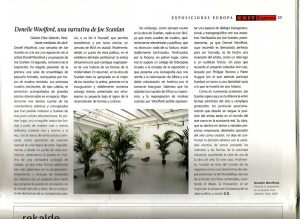
Exit Express, European Exhibitions, 2007
Donelle Woolford, a narrative by Joe Scanlan
Galerie Chez Valentin, Paris
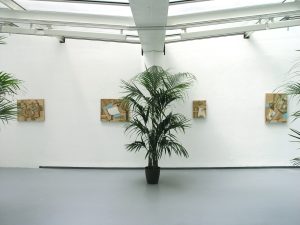
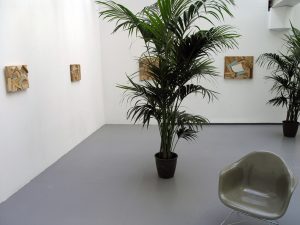
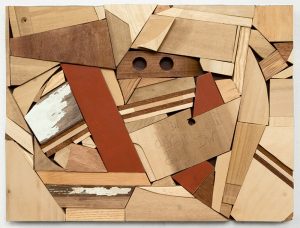
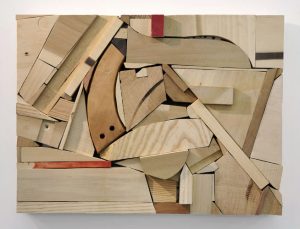
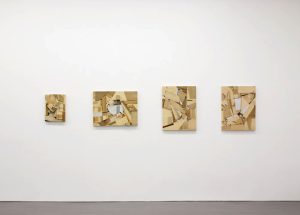
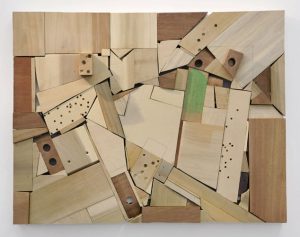
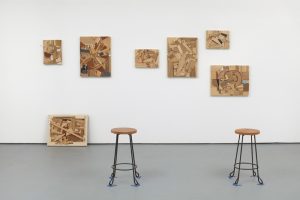
Donelle Woolford, a narrative by Joe Scanlan is simultaneously an exhibition by Donelle Woolford and a project by Joe Scanlan. The exhibition’s second artist has chosen to present a series of small-format assemblages by the first, composed of pieces of reclaimed wood. The resulting exquisite, Cubist-style works are displayed alongside large plants scattered throughout the space. We quickly realize the formal and conceptual characteristics of this young African American artist that may have interested Scanlan. First, an undeniable formal appeal derived from more or less ordinary wood—a material at once living and dead—bearing the mark of a certain artisanal practice, as a manual creation process within a serial logic. Subsequently, and from an economic perspective, we observe the implementation of a genuine ecology of work. Since these abstract forms have been obtained through the recovery, treatment, and recharging of materials, there is a connection with Scanlan’s Ikon Earth project—which proposes introducing a collection of waste materials (derived from their previous composition) into the art world and beyond—or his “Do It Yourself” project—which allows for the transformation, and thus the recycling, of an IKEA wardrobe into a coffin. Finally, from a political standpoint, it stands as an emblem of professional success: the African American artist who manages to reclaim a history of the forms of modernity. In short, in Scanlan’s work, everything is appropriated in the best of all possible worlds: the artist—present at the opening and visibly pleased with herself—enthusiastically presented her project under the banner of reconciling forms and cultures.
However, as is always the case in Scanlan’s work, nothing is so simple, since these seemingly elementary and simple wooden panels, which make no attempt to conceal their workmanship, are doubly enchanted. Enchanted by history, firstly, as suggested by a collage of photocopies located at the entrance to the exhibition, which presents iconography alluding to the colonization of Africa and the double colonization of America through the triangular trade. We know that the Cubists drew their inspiration from Africa, and Woolford’s reappropriation of Cubist motifs could represent a kind of transgenerational and transgeographic dialogue with their ancestors. Later, they became captivated by Joe Scanlan—since Donelle Woolford, whose career trajectory is too perfect to be genuine, is in fact an invention of the artist, acting as an alter ego or a fictional stand in. A move reminiscent of the collective *Ann Lee* project—launched by Philippe Parreno and Pierre Huyghe (and in which Scanlan also participated)—centered on an empty identity endowed with a backstory.
As is often the case, Scanlan operates here within the gap between accepted art forms and complex protocols. It is a distinctive stance that relentlessly challenges the artist’s position in both the art world and the real economy. His work—manifesting in a wide variety of projects as entrepreneur, designer, and art practitioner—constantly confronts artistic decision-making with actual activity, borrowing the methods and forms of industry while embracing the artwork’s use value. Ultimately, Scanlan employs the business world of storytelling as a form of positivist utopia: the use of fiction for commercial ends to spark desire and innovation and to foster self-improvement through the projection of a political and social ideal.
G.D.
___________
Some other critical responses, in no particular order:
Rachel E. Blackburn [requires a valid JSTOR login]
Marissa Perel [scroll down]
Whitney Museum of American Art
___________
PRESS RELEASE
Donelle Woolford
Performer / Performer / Audience / Mirror
Saturday, May 8th, 4:30 pm
Cedar Lake
547 West 26th Street
As part of the first annual New York Gallery Week, Donelle Woolford will perform a new staging of Dan Graham’s Performer / Audience / Mirror, which was first performed by Graham in 1975. Woolford’s adaptation of the landmark performance will take place on Saturday, May 8th at 4:30 p.m. at Cedar Lake Contemporary Ballet, 547 West 26th Street. Woolford’s version of the performance was first workshopped at the Lewis Center for the Arts at Princeton University in March of this year.
Woolford is a New York-based artist represented by Wallspace who does not have a fixed identity. She is primarily known for wooden assemblage paintings in which she interrogates Cubism’s dubious African origins, as well as her own fractured point of view. In the movements and observations of Graham’s Performer / Audience / Mirror, Woolford has found a more up-to-date perceptual model through which she can further articulate her character, measuring herself not only in relation to the audience from which she emerges and the mirrors that are her backdrop, but also in relation to herself.
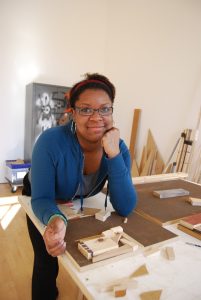
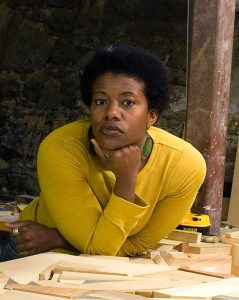
Jennifer Kidwell is an actress and singer living in Brooklyn, New York. She holds a B.A. in Literature from Columbia University and has studied acting with teachers from Juilliard, Yale University, and The New School for Social Research. Recent roles have been a chorus member in “The Bacchae” (Joanne Akalaitis, Philip Glass, David Neumann) as part of The Public Theatre’s 2009 Shakespeare in the Park, as the character Blackgirl in “A Raisin in the Salad: Black Plays for White People” (Kevin B. Free) as part of the 2010 Fringe Festival New York, and continual participation in the clown troupe Logic Limited.
Abigail Ramsay works in the performing arts as an actor, director and administrator. She received her BA from Brown University and is a graduate of England’s Royal Academy of Dramatic Art, London, where she was active in the theatre and in BBC 4 radio plays. In 2009 she participated in the launch of Ruffled Feathers Theater Company, Brooklyn, and in “Shoot to Win” at the Cherry Lane Theatre. She lives in Brooklyn.
For more information contact:
Wallspace
619 27th Street
212 994 9478
info@wallspacegallery.com
___________


___________
KARMA CHAMELEON: AN INTERVIEW WITH A DONELLE WOOLFORD
LORENA MUÑOZ-ALONSO: I was reading David Joselit’s piece on you, in which he describes you as a quasi-mythical character and as an ‘avatar’, which allows “for an imaginary/real mobility” that a regular artist lacks. I am wondering how do you interpret this concept of mobility and why it symbolizes something positive or desirable?
DONELLE WOOLFORD: The dichotomy of “real” and “imaginary” reminds me of the three beds in Plato’s Republic. Though Plato was quite confident about the distinctions he drew between the idea, the object, and the representation of a bed, in our time we’re no longer committed to such certainty. If I’m enjoying some kind of mobility it’s between these levels of being, and this chimerical quality is key to myth. It allows me to be fixed and flexible simultaneously. There is the underlying notion of Donelle Woolford as a young artist—my character, so to speak—and then there are the particular embodiments of that character by the different actors who interpret me. Myth allows me to be in several places at once, or instantly fluent in German, or tall, or somber, or handsome. Every version of me is different, and yet every version is still me.
LMA: In your artist statement you define yourself as the “quintessential market artist.” Could you explain what you mean by that exactly and how that relates to your political agenda?
DW: I’m just trying to claim some valuable intellectual territory for the Left. I’ve never understood why so-called political artists almost completely cede the power of commerce to conservatives. The belief that refusing to make saleable art objects somehow symbolizes a critique of the retail art market is dubious and shortsighted. Eliminating the object of exchange only turns the artist herself—or the event, or the community involved—into commodities that get bought and sold in the institutional marketplace of museums, biennials, and state-funded public art. What gets referred to somewhat lazily as commodity critique is really only a transformation—an exploitation, really—of systems and networks of people into saleable objects. That doesn’t sound very liberating to me, in fact it sounds quite corporate and repressive.
LMA: Your narrative as a working-class black female is written by Joe Scanlan, a middle class white man. Do you have any idea why Joe decided you should fit this description, what were his most intrinsic reasons and thoughts to engage in a race and gender conflict that doesn’t really affect him that much?
DW: Actually you have it backwards. Joe is the working-class artist, I’m the privileged one. My father was a real estate lawyer who made a successful transition into entertainment law. My mom is a natural healer and author. And I graduated from Yale University. If I were to say anything about Joe’s characterization of me it would be that he wrote me to be everything that he is not. That works in the basic black / white, male / female kind of way, but it also works in terms of class and education and family history. I’m everything he is not in those ways too, and that also matters.
LMA: How necessary are you for the art world?
DW: I think we’re all only just beginning to learn the language of perception as it relates to social space. Our vocabulary is quite narrow, actually. For a recent show at White Flags Projects in Saint Louis, I created a piece based on Piaget’s theory of the conservation of volume. This theory deals with development and perception: at a young age, people associate volume (size) with shape, regardless of what they might have previously known or seen to the contrary. At the opening, I got to experience (and experiment with) reactions that I attributed to shifting perceptions of my portrayal. Throughout the opening, I would periodically change out of character whenever I climbed onto one of four risers built for the occasion that were of slightly different heights. Although my portrayal changed back and forth throughout the opening, my physical form remained unchanged. Some people had a hard time dealing with that because, like the Piaget experiment, they were not able to apply knowledge from previous perceptions of Donelle to the situation of Donelle in the present. Others just rolled with it and played along. It felt pretty important.
The performance challenged notions of provenance. It challenged my audience to reckon with who they think I am, who they’d like me to be, and what relation, if any, that reckoning of Donelle Woolford has on the perception of her work. If that’s an experience we need to have as an audience, then I guess I’m necessary for the art world.
LMA: I remember I went to see Double Agent at the ICA almost three years ago but I completely missed the point of your work. You were not in the gallery in that particular moment, and I didn’t even know you were an ‘avatar’ so my experience was reduced to the sight of an empty studio. What happens with Donelle’s agency when the viewers fail to grasp her true essence? Is it diminished or, on the contrary, multiplied?
DW: My agency is quite vast when you don’t know anything about me, but the more you learn the tighter and smaller I get. However, just when you think what you know about me will annihilate your curiosity, the fact that I am portrayed by many actors who are empowered by their portrayals flips the whole premise on a point, like light passing through a pinhole, and my agency expands again. My essence is kind of like a solar eclipse: I’m best viewed upside-down and indirectly. Like Marcel Broodthaers said, ‘fiction enables us to grasp reality and, at the same time, that which is veiled by reality’.
LMA: Double Agent was a very interesting show in that it addressed situations wherein artists use others to make their work. Have you ever felt exploited in an artistic working relationship, like for example with Joe?
DW: No. I’m an actor playing a complex, improvisational role on a stage where the boundaries are constantly shifting. It’s a great challenge and a great learning experience, something that seldom exists in the theatre world because the whole project is too formless. But that’s what allows me to have a say in where Donelle’s character is going, what I think she should or shouldn’t be. Plus the role has taken me to Sharjah, Amsterdam and London and put me on stage at the PRELUDE festival and the Guggenheim. As a young actor, it’s great. I guess you could say that Joe and I exploit each other. I get to inhabit and work through a character in ways that are beneficial to me, and Joe gets to try out artworks through a kind of lens that allows for different kinds of authorship. He likes having that lens, and I like being it, but for different reasons.
LMA: At the end of the day, what is more important to you: your work in itself or the debate around the questions of gender, race and authorship that it generates?
DW: The work. What’s interesting is that for me, the work is the portrayal, and for Joe the work is the work.
A longer version of this interview was first published in An Art Newspaper (Berlin: vol. 10, no. 23, April 2011): 27–28.
___________
___________
REHEARSAL Transcript for “Dan Graham Withdrawal Syndrome”
Wallspace, New York, 2009
Suburban, Chicago, 2009
Cooper Union, New York, 2011
Carlos Ishikawa Gallery, London, 2012
THE SET
[Two women sit askance from each other in the front of the room like a host and their guest on a television talk show. They can be seated in club chairs, on stools, whatever is convenient and available.]
DONELLE [ABIGAIL]
So, the relationship of your work to cubism is clear…. Don’t you think?
DONELLE [JENN]
Is it?
DA
Well, is it about appropriation then? I mean, the title of your last show at Wall Space was “Return,” so it begs the question, return to what? Is it cubism—or since you used so many wood scraps, are you calling for a return to nature or to manufacturing? Or maybe this has something to do with Jacques Lacan . . .
DJ
I’m not sure about the return to manufacturing part, but if you want to talk about my work in terms of REUSE, yeah, you could say that. That whole line of reasoning makes me think of a compass, a circle, 360 degrees. If you start at zero, you can think about the discarded MATERIAL I use, the scraps I collected from a factory adjacent to my old studio in New Haven. Organic material that was the residue of AN INDUSTRIAL process that I appropriated for my own use. If you turn 90 degrees from that, that would be my work. You can say that it looks like cubism, I LIKE THAT ASSOCIATION … whether it is true or not … that would be an appropriation of a kind of form, a known historical style. You turn another 90 degrees from that and look at cubism, cubism is an appropriation in itself—it’s European artists looking at African art, using those forms to create new art. You turn 90 degrees from that, and there’s me.
DA
So is your work autobiographical?
DJ
[PATRICIA HIGHSMITH ANSWER. RIPLEY UNDER WATER. PAIR OF GALLERY OWNERS HAVE LUCRATIVE BUT SEVERELY DEPRESSED PAINTER. THEY FEAR HE WILL KILL HIMSELF AND CUT OF THEIR CASH FLOW, SO ONE OF THEM LEARNS HOW TO MAKE FORGERIES OF THE WORK. SURE ENOUGH, THE PAINTER KILLS HIMSELF. THE GALLERY DIRECTOR STARTS MAKING THE WORK WITH THE IDEA THAT IT WILL GRADUALLY BE SOLD AS THE TROVE THE PAINTER LEFT BEHIND. BUT THE MORE PAINTINGS THE GALLERY DIRECTOR MAKES THE MORE DEPRESSED HE GETS, UNTIL ONE DAY HE KILLS HIMSELF TOO. I LIKE THE PROPOSITION THAT PAINTINGS AREN’T INDICATIVE OF AN ARTIST’S PSYCHE, MAYBE THE ARTIST GETS HIS PSYCHE FROM THE PAINTINGS.]
DA
You know, I’m interested in authenticity—or the lack thereof. Who can say whether the work of an artist has anything to do with her life story? I like to think of names like MARK TWAIN OR RROSE SELAVY OR SASHA FIERCE. I mean, it’s just that, it’s just a name. But what really matters is how you put yourself out there. I like to think that I’m putting myself out there as Donelle Woolford with strength and conviction.
DJ
I have noticed that you use a lot of white space, a lot of empty space, in your installations. For instance, I remember in one of your shows there was a great expanse of empty wall, and then another wall where the paintings were clustered together in a tight grouping. Can you speak about installing your work that way?
DA
I think about the installation … the same way I think about making a single painting. I use SCRAP MATERIAL, and from that limited collection of shapes I develop a painting and come up with something that looks like a collage.
DJ
HOW DO YOU KNOW WHEN A PAINTING IS FINISHED?
DA
You know for me, it’s never finished. I just move on. There comes a point wheN the piece becomes all surface and sort of seals itself off. The great American painter Stuart Davis WORKED KIND OF THE SAME WAY, he would start each painting with a single brush stroke, a discreet mark—one that he always thought of as a wrong gesture, A mistake. All his subsequent brush strokes were a response to that mistake and a way of shaping it, a way of ‘correcting’ it so to speak. He liked to say that he didn’t finish his paintings, the paintings actually told him when they were DONE. He was a big fan of bebop and improvisational jazz, and THE IDEA that jazz can work the same way. you start off with a note and that each subsequent note is a response to that initial sound that helps build the composition.
I APPROACH INSTALLATION THE SAME WAY. Once I have several paintings, I put them on the wall in GROUPINGS that almost represent—
DJ
—So you’re looking at EACH painting as a collage fragment in the group?
DA
Exactly. Then if you take the entire space you have a series of collages, for example I might have one wall that has nothing on it … and another wall that might have a table, a sofa and maybe one painting—
DJ
YOU’RE using architecture to create form—
DA
Exactly. And beyond that, we can expand this idea TO include the people in the gallery, AND THESE TAPE MARKS, AND YOU AND ME. I like to think of it as a collage of space, a kind of social space that is controlled by my arrangement of it.
DJ
WHAT ABOUT THE PLANTS?
DA
That’s the show. IT’S ALL THE SHOW.
[AWKWARD SILENCE]
DA
Since we’re talking about your WORK, how do you know when A PAINTING IS finished?
DJ
Do you remember that whole kerfuffle with Serena Williams at the US Open a while back? There was this controversy, she verbally abused a line judge during match point in the semifinals and lost the match. There was this big to do, and I remember watching and just being struck by the questions the reporters were asking her. There were two that stuck out, the first one was “What did you say?” and she said “excuse me”? and the reporter said “can you tell us what you said?” and she looked at him and she said, “I think you heard me, next question,” and she moved on. And then later, another reporter asked her “well, why do you think this happened today, do you think the weather had anything to do with your response to your opponent?” and she looked at that reporter and she said, “The weather? The weather? That’s the craziest question I have ever been asked. The weather? You know, people usually get angry when it’s hot outside, its cold today.” I feel that way about making art. I’m in the PRESSURE of the moment and then I JUST move on.
[AWKWARD SILENCE]
DJ
Have you seen anything that you liked lately?
DA: Well, yeah, I did actually, there is this contemporary dancer / choreographer named Trajal Harrell, he does particular sizes of dances and I think the size I saw was ‘s’ for ‘small’.
DJ
Performance size small?
DA: Yeah, it’s the same title but there’s an extra small, an extra large, large, medium. But, I saw the small. Basically the stage was set up like a catwalk in the middle of the room, with some really gorgeous and expensive clothing on racks and pretty deep theatrical lighting, but empty. All of us were given a card when we walked in—
DJ
—It was like a fashion show—
DA
It was like a fashion show and you could check off what you liked. It’s interesting because he had some styles that were west coast and some that were east coast, they were very specific, and the performance consisted of Trajal putting on outfits and then taking them off. When he was finished putting each one on, he would just stand at the edge of the stage and STRIKE a pose like that [fashion pose] and that was it, that was the extent of his movement. It was extraordinary—I went to see a dance performance and this is what I saw.
DJ
You expected something more traditional. Like dancing.
DA
Yes, I expected to see movement, exertion, skills.
DJ
So why do you think that is? Why did he opt out of being impressive, of giving you a demonstration of—
DA
—I don’t know if he opted out, I don’t know what my expectations really were now that I think of it. This question is something I really don’t understand. All I know is that he did very little, he got to wear some great clothes, he hardly broke a sweat and the critics raved about it. And that kind of makes me wonder well, what do we value? If success comes by doing very little work, then what is the point of training, questioning, becoming a virtuoso. There is something about our culture that is completely DECADENT. The fact that you spend so long studying and becoming a master at your field and all of a sudden you get on stage and people are expecting to see something and what your seeing is the most minimal, seemingly minimal type of expression. I don’t know… I don’t know… it was just a waste.
DJ
That reminds me of a passage IN AN EARLY Dan Graham essay, “New Wave Rock and Feminism” I think it’s called. He does an analysis of singer songwriters versus punk musicians—singer songwriters like Bob Dylan, Van Morrison, Joni Mitchell—and he examines their need to share, their need for this experience of the music to be “I”. You know, this is me and this is how I’m feeling at this moment, this is what these musicians would share. Really hinging on the sense of the audience and that they are there to look at the artist, to experience a real artist. Punk music turned that on it’s head, punk music was about distancing, about the elasticity of saying to yourself, I’m going to make a decision about who I am. I’m going to make a decision about how this show is, I’m going to make a decision about how I choose to dress, that this really doesn’t have anything to do with me as “I”. That punk musicians made the choice to distance themselves from sincerity, from over-sharing. What I LIKE ABOUT THIS is the idea that the over-sharing of the singer songwriters, ironically, ultimately produced a lack of interest. Right? The audience was sort of oversaturated with who that person on stage was, as opposed to the mystery, the allure of the mystery, or the sheer camp of their artifice.
DA AND DJ
[In unison: A CLAMOR, IDEAS RUSHING AROUND YOUR HEADS, BOTH OF YOU TALKING AT ONCE]
DJ
SO, IS YOUR WORK ABOUT APPROPRIATION?
DA
You could say that. Appropriation makes me think of a compass, a circle, 360 degrees. If you start at zero, you can think about the discarded material I use, the scraps I collected from a factory adjacent to my old studio in New Haven. Organic material that was the residue of an industrial process that I appropriated for my own use. If you turn 90 degrees from that, that would be my work. You can say that it looks like cubism, I like that association … whether it is true or not … that would be an appropriation of a kind of form, a known historical style. You turn another 90 degrees from that and look at cubism, cubism is an appropriation in itself—it’s European artists looking at African art, using those forms to create new art. You turn 90 degrees from that, and there’s me.
[FROM HERE ON IS IMPROVISING AND RIFFING ON THE COMPASS IDEA, 360 degrees, FULL CIRCLE, ETC. GRADUALLY GETTING SHORTER AND TIGHTER]
DJ
Yeah, it’s sort of like a clock. You start at 12 and that could be noon or midnight and you sort of go, a quarter of a distance, at the starting point there is the origin, the organic kind of life force material. Wood and what that means and my use of it. This discarded wood is being modified and taken through a sort of . . . mechanical reproduction. I repurpose it, reinterpret it. How am I reinterpreting it? Some people say it looks like Cubism. The opposite of an eternal life force… Will this be a reinterpretation of art, this interaction between Europe and Africa, this first meeting to create a new art. Well, if we swing that up opposite my work, there is me.
DA
You know, when I think of my work I think of the gears on heavy machinery, kicking it’s gears backwards into time. You can almost hear the cranking noise of the metal, it’s moving and cranking and getting tuned up and then when you pull back and you the collection of parts, you know, the teeth, I sometimes see an aesthetic machinery in my work that reminds me of Charlie Chaplin, Buster Keaton, even Jacques Tati. An alienation. These masters had ideas about how they had to just keep moving and getting fit together again, the character being a gear moving through this machinery of what I’m saying is art.
DJ
I like to look at it like the cross section of a tree, there are the grains in the center circles like starting at the center where the seed was planted and coming up through the central idea would be the wood, to start there and radiating out. So, my wood, my work…. my way of working with the wood. Branching out from there. The same way I’m working with wood is how Europe was working with Africa, sorting out and reifying a mix of nature and culture, and then there is me.
DA
It’s like a sundial. You start off at one point and you have that energy from the sun. That illuminating force, how it starts at one point and slowly comes around and my work outside of that. All the things that develop, the wood, the painting, the saw, making sure everything fits and how this material was in existence one hundred years ago, how these guys were able to put their ideas behind art and multiculturalism and swinging around again and you come back to me.
DJ
You have, like, a vat of boiling oil and you have batter and everything is percolating and working through and what happens when the batter gets poured in and becomes a donut or a funnel cake. The way it’s moving around and through and so on and so forth and then it’s served up as a product.
DA
I think of airplane return trips. You start off with one space and then there is that long passage of development from Europe, going to Africa and then from Africa back home, and then there’s me.
DJ
Sort of like a sling shot, going backward and going forward.
DA
Right. Here, there, and then me.
DJ
Backward and forward.
END
___________
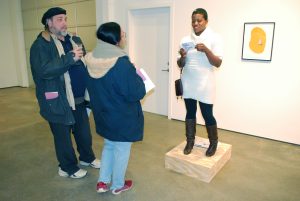
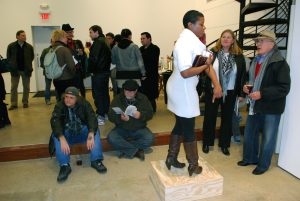
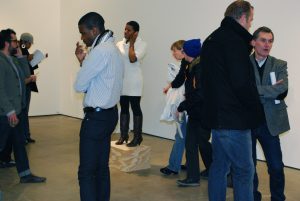
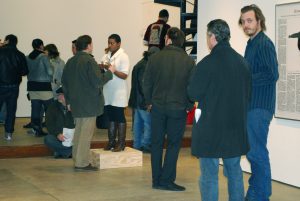
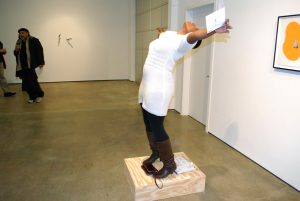
Piaget, 2011
White Flag Projects, St. Louis
An improvisational performance involving four theatrical platforms of different height but equal volume. Jenn Kidwell acted as live intermediary between the height and placement of the platforms, the gallery visitors, and instructions texted from Abigail Ramsay and Joe Scanlan.
___________

MARCEL JANCO INTERVIEWS DONELLE WOOLFORD
MARCEL JANCO is the co-founder of Sabot in Cluj-Napoca, Romania. His essays and interviews have appeared in the Last Observer, Oracle News, IDEA art+society, Maayan, and Pylône.
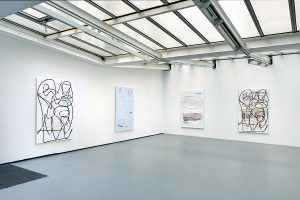
MARCEL JANCO: Your show in 2008 at Wallspace consisted of works made from wood scraps, latex paint and cardboard screws hanging on the wall and the space is enriched by plants standing on minimal plinths. It appeared to me like Cubism and Marcel Broodthaers meeting Ikea. What do you think?
DONELLE WOOLFORD: That’s a pretty good description. Broodthaers work touched on three themes that are very important for a successful business strategy: 1) choose something and focus all your energy on it; 2) one thing is good, two of them are better, three is even better, et cetera; and 3) once you have someone’s attention, confuse them into buying something.
MJ: Where did you train and who was the artist who made you think you wanted to become an artist yourself, if any? What are your influences in life?
DW: I first trained with the little-known artist Lester Hayes at a summer camp in North Carolina. I went to school at Yale and got a degree in graphic design, but I was more interested in painting and sculpture. Joe Scanlan was the professor there who made me realize I had good ideas, I had a good sense of humor, and that I could make it on my own. He also helped me see the legacy of my interests in narrative and mythmaking. Not so much Warhol, that’s everyone’s boring influence and a lazy one at that. He turned me on to Manzoni, Adrian Piper, Broodthaers, Palermo, Sherrie Levine, Richard Prince, David Hammons.
MJ: Your following show at Wallspace in 2010 had a quite similar body of work, but there you activated the room with a one-night performance where you were “talking to yourself.” I’m saying this because I’ve read that people have seen you performed by Namik Minter in the United Arab Emirates, by Abigail Ramsay in London and at your first show at Wallspace in New York by Jennifer Kidwell. For the latter performance where you were “talking to yourself,” it was Ms. Kidwell and Ms. Ramsay portraying you simultaneously. Could you clarify, if possible?
DW: I am not real. I am a character whose story is being written and played out by a number of interested authors and actors. I exist as a known entity of sorts, just like a character in a well-known play. But each time I’m on stage, each time I have a show, my character gets transformed by the work that I make and the subjective interpretations of the actors who portray me.
MJ: Alison Gingeras has written that artists like Warhol and Kippenberger were using their persona as an artistic medium. Is that your case? Being a female artist do you think there’s a legacy as such for female artists?
DW: Perhaps, although unlike Warhol my persona remains unfixed. I prefer Kippenberger because he really did transform himself over the years from earnest young hopeful to savvy operator to middle-aged rhinoceros. And despite Kippenberger’s celebrity as a person, all his best works were made in private, were the anxious product of a studio practice. All the artists I mentioned above, Manzoni et al., are important to me because, unlike Warhol, the idea of fiction and celebrity for them is still located in the artwork rather than in the personality of the artist who made it. The merde d’artiste, the snowballs, the cowboys, the hotel drawings are what circulate and become known while the artist as a persona remains somewhat unclear.
MJ: A friend of mine founded his seminar at the Yale School of Art on these three topics: 1) an anti-hierarchical perception of the field of art, in which artists, curators, gallerists, collectors, editors and critics are all considered “players” of the same game; 2) an expanded definition of practice, in which the figure of the artist is considered not only the “creator” of an artwork, but a cultural operator able to write, manage galleries, curate, and collect; and 3) the consideration of the entire discourse around the artwork, including its conception, creation, production, presentation, distribution and dissemination. Is that your case as well?
DW: No. I am an artist. If I have an anti-hierarchical perception, then it is against the idea that an artist has to have an essential identity that is embodied by one person only. I am anti-hierarchical in that I can be represented by half a dozen people in a half a dozen places all at the same time, and all of them are real and true and actual representations of Donelle Woolford and her work. This one is tall, that one speaks German. This one is grumpy, that one is beautiful.
What is interesting about your friend’s approach to me is that the more you break down the hierarchies and the more everyone can be responsible for all facets of cultural production, the more possible you make it for an Ubermensch to run absolutely everything. Your friend’s approach can create a useful democracy and confusion, but it can also create monsters. That is an interesting risk to take, but I’m not sure it’s worth it. Look what it has given us: Hans Ulrich-Obrist!
MJ: “Still Life,” your installation at the 8th Sharjah Biennial, was like bringing a microcosm of a studio—your studio, I assume since it was full of wood scraps—to the exhibition space. It was like showing something we don’t usually see. It reminded me of the recreation of Brancusi’s Studio outside the Pompidou in Paris and I think Josh Smith has done the same in the past. How do you position your choice? Is it about voyeurism and celebration, as it is for Brancusi, or rather more like Josh Smith’s pornographic and bulimic gesture? Is there a middle path perhaps?
DW: I prefer the model of Raymond Roussel. I think the artist’s studio is like one of those refrigerated chambers in Locus Solus in which recently deceased people eternally re-enact the moments leading up to their death through the injection of a special drug. All the accoutrement of their final moments are there with them to make the event as accurate as possible. I think the artist on display is like that, the public display being a kind of perpetual death acted out for the sake of scholarship and entertainment.
MJ: On the website of your Paris gallery, Chez Valentin, your bio doesn’t have the same structure as that of the other artists. It doesn’t include group and solo shows. Instead, it recounts your life since you were born, as you find sometimes in catalogues of dead artists. Why is that?
DW: See above.
MJ: In a text about your work, gallerist Joe Tang ends with writing: “Donelle Woolford, Narrative artist. Donelle Woolford, Cubist painter. Donelle Woolford, avatar. The possibilities are endless.” Could you please explain? Who is Donelle Woolford?
DW: I don’t know. Maybe the better question is, “What is Donelle Woolford?” folk legend? A product? A myth? Maybe she’s the outcome of a demographic being continually recalibrated to reflect the desire for an artist like Donelle Woolford.
___________
DO IT
by Donelle Woolford
1. Get Rich.
2. Become an artist.
3. Get Rich.
First published in the online version of Hans-Ulrich Obrist’s Do It, 2002.
___________

___________
Press Release: Donelle Woolford: MaLeVoLeNcE
Air de Paris and Galerie Chez Valentin, Paris
opening reception: October 26, 2012
Palais de Tokyo
October 27, 2012
Donelle Woolford’s new work is malevolent.
Having experienced the joys and challenges of being an emerging young artist, she isn’t so interested in spending the next twenty years mounting more solo shows, getting reviews, participating in biennials, et cetera. Instead, Woolford has decided to just assume the identity of a mid-career artist now. As a fictional character she can do that. All she needs is a motivation, a few plot points, some conflict, and presto: Act II. With the wave of a hand, Donelle Woolford is 58 years old and blissfully immersed in the wisdom that comes with being a mid-career artist—the most complex, committed, vivid, truth-telling, vulnerable kind of artist you can be.
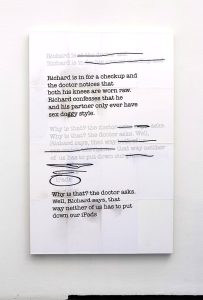
Through a series of “joke” paintings, MaLeVoLeNcE chronicles the adventures of a character named Richard. Who comes to mind when you complete this spelling in your head
R-I-C-H-A-R-D P-R
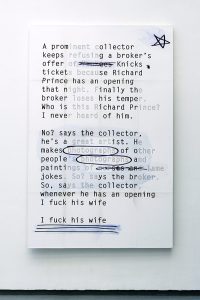
Richard Pryor, or Richard Prince? Whichever one emerged from your subconscious, it placed you (and them) in one demographic instead of another. Richard Pryor was black. Richard Prince is white. Richard Pryor told jokes, Richard Prince paints jokes. Richard Pryor invented a racially explicit brand of comedy that, once begun, could not turn back, no matter how destructive. Richard Prince instigated the act of appropriation, a gesture that, once made, could not turn back, no matter how productive. Woolford’s Joke Paintings investigate this destruction/production dichotomy, two sides of the same coin. In Woolford’s case, she flips the coin with the aim of having it land on its edge.
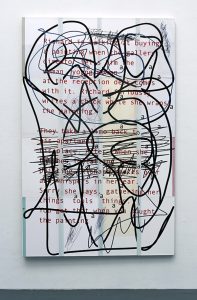
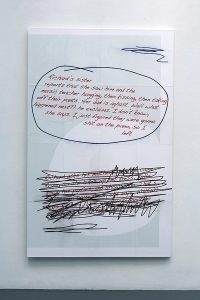
As images, Woolford’s paintings deepen her commitment to making artworks that “look like” known artists and styles. Woolford’s paintings are stand-ins, facsimiles, stage props. The paintings, rendered in marker, acrylic paint, and ballpoint pen, have all the telltale signs of “process” and “revisions”—evidence of the artist thinking out loud—except that in Woolford’s case, all the evidence has been figured out beforehand.
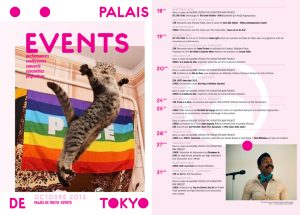
The paintings are accompanied by “Dick’s Last Stand,” a 40-minute performance that will take place at the Palais de Tokyo. “Dick’s Last Stand” is a faithful re-enactment of the last stand-up routine Richard Pryor performed for his short-lived network television show in 1977, a genius work of deconstruction and subversive social commentary that, despite it’s original censorship, everyone should see. The paintings and performance are accompanied by Dick Jokes, an extraordinary volume of ridiculous phallic humor compiled from throughout North America over the past fifty years.
Donelle Woolford (b. 1954 in Detroit, U.S.A.) lives and works in New York City, Brooklyn, The Bronx, Philadelphia, London, and Vienna. She has participated in the exhibitions Double Agent at the ICA London; The 8th Sharjah Biennial, United Arab Emirates; and Buy American at Galerie Chez Valentin, Paris. Her performances have been staged at The Solomon R. Guggenheim Museum and the PRELUDE theatre festival, New York; The Lewis Center for the Arts, Princeton; The Suburban, Chicago; White Flags, Saint Louis; and the Yale University Art Gallery, New Haven.
___________
___________
FROM RICHARD PRYOR TO RICHARD PRINCE
Karima Boudou
‘I’d like to be remembered in a movie. I know that sounds preposterous. But having someone else play me is pretty much what I think I’m already doing.’
RICHARD PRINCE, in *The Velvet Grind*, David Robbins, JRP | Ringier, 2006.
Donelle Woolford is a fictional artist created by Joe Scanlan. She challenges, more than ever, the importance of artistic ownership and the role of personal identity in shaping a given work. From Joe Scanlan to Donelle Woolford, from Donelle Woolford to Richard Pryor, and from Richard Pryor to Richard Prince, the reification of myths surrounding art enables a critique of them—and an understanding of the still-taboo issue of the representation of so-called ‘Black’ artists in contemporary art in Europe and America.
FROM DONELLE WOOLFORD TO RICHARD PRYOR
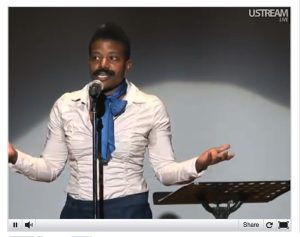
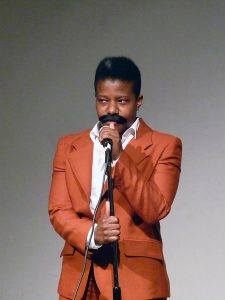
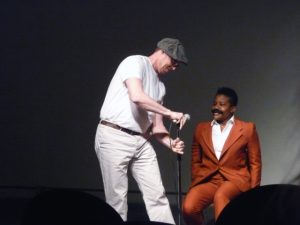
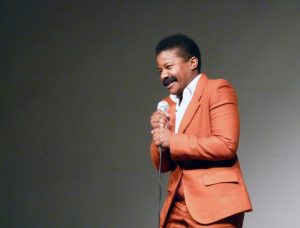
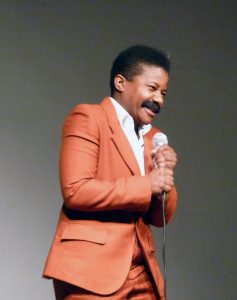
Donelle Woolford is a mid-career artist based in New York, and she represents the manifestation of fiction within reality. Fully embracing the identity of an African American artist, Woolford reveals how the myths and narratives constructed around art can be both reified and critiqued through the lens of deconstructing identity and storytelling. Her work seeks to challenge the impulse to conform to society’s dominant logic. A manufactured myth, Joe Scanlan’s project embodies the very act of narrative construction. It also contains an implicit critique of the “star artist of the moment” and the art world’s almost blind faith in the authenticity of artistic subjectivity. Donelle Woolford has been embodied by nearly four African American actresses hired by Scanlan over the past few years. Scanlan provides them with specific instructions prior to their appearances at contemporary art events, exhibitions, biennials, and lectures. He strikes a nerve by “casting” the work of a contemporary artist; this approach echoes the self-selecting nature of the contemporary art world—a realm that largely mirrors itself, lacks diversity, and champions the authenticity of the artwork. In Dick’s Last Stand—a performance recently staged for the first time in France at the Palais de Tokyo (Paris)—Donelle Woolford reveals her recent career shift toward comedy. During the performance, Woolford faithfully reenacts the second and final episode of “The Richard Pryor Show,” which originally aired during prime time on American television in 1977. The US network ABC cancelled Richard Pryor’s show, likely deeming him too incisive for an American society struggling to confront its own reflection. For the performance, Woolford wore a fake mustache in reference to Richard Pryor’s own, and reenacts one of Pryor’s characters, Mudbone—an elderly Black man from the American South. Pryor recounted that he learned many stories through this persona; Woolford thus explores the contingencies of his own identity through shifts in identity that underscore the failure of singularity and authenticity in art.
…stand-up comedian in the United States. Woolford reprises one of Pryor’s characters, Mudbone—an elderly Black man from the American South. Pryor recounted learning many stories through this persona. Woolford thus explores the contingencies of his own identity through shifts that undermine the concepts of singularity and authenticity in art.
FROM RICHARD PRYOR TO RICHARD PRINCE
Richard Prince is an American painter and photographer who has been appropriating photographs since the 1970s. Does this reappropriation reinforce a logic of production? What is the connection between Richard Pryor and Richard Prince? Drawing a parallel between the two inevitably creates a situation of mutual exclusion. Pryor was Black; Prince is white. Pryor was a stand-up comedian who told incisive jokes that offered a scathing critique of race relations, whereas Prince painted his “monochromatic jokes” between 1987 and 1990. Prince drew upon stand-up comedy and burlesque humor to mischievously project the sexual frustrations of the American middle class onto his paintings.
Recently, in two Paris exhibitions titled *MaLeVoLeNcE* (at Galerie Chez Valentin and Galerie Air de Paris), Donelle Woolford presented paintings described as “malevolent.” Executed in acrylic, marker, and ballpoint pen, these works are displayed as scenographic elements; they recount the story of a character named Richard—who experiences various adventures in the New York art world—and portray a malevolent persona that flirts with amorality. This approach inevitably entails working through ellipsis and the void. While many contemporary artists focus on an attitude of simply “being where I am,” Woolford appears acutely aware of her own position—a position she subsequently seeks to probe and explore. Donelle Woolford’s practice thus shatters the conventional framework of contemporary art. She teases morality from an amoral standpoint, offering an implicit critique of the image-centric discourse prevalent in contemporary art today. Moving from one figure to another—from Richard Pryor to Richard Prince—one realizes that this multiplicity defies totalization, arising instead from a constant interplay between the insignificant and the manifold. Contemporary cultural activism posits that the notion of truth can be dispensed with; there are only distinct cultures, and we are capable of admiring the products of these various cultures. Should artistic heritage be viewed as a succession that constitutes an approach to art history?
The fact remains, however, that Woolford crafts a work of identity deconstruction comprising various layers and identities that are successively appropriated: Joe Scanlan, Donelle Woolford, Richard Pryor, and finally Mudbone. Is the performance spectator an unwitting victim placed in a position of “white” privilege? Regardless, this situation likely reenacted the position of American viewers sitting before their television sets in 1977, echoing the context of this performance at the Palais de Tokyo. *The Richard Pryor Show* implicitly highlights a pivotal moment in the history of the US civil rights movement, when censorship eliminated any possibility of concrete confrontation. The artist also holds up a mirror to the art world—a realm that strives for theoretical comprehensiveness yet has historically struggled to demonstrate this in practice. Woolford’s example interrogates the concept of diversification in contemporary art and the complexities surrounding the representation of African American artists within that system. During the performance at the Palais de Tokyo, Woolford opened up a space for reflection on the European cultural imagination—a realm whose legacy is dominated by the image of the solitary, tortured white artist at work in his studio.
Karima Boudou is an art historian and curator based in Ghent. She participated in the De Appel Curatorial Programme at the De Appel Arts Centre, Amsterdam.
___________
All About Eve (an email)
January, 2013
Hi Michelle,
I hope this finds you well. How are your shows going in Chicago? Things are good here in the Bronx, I just turned down a last-minute show opportunity here in NYC and that always puts me in an omnipotent mood. There are few words more delicious than “no.”
The opposite is true in the case of the Biennial, though, and I am happy to get back to you with some thoughts about the generous invitation you extended to Joe. He told me all about it, and the prospects are very exciting.
He isn’t here right now — he just shipped a show to Amsterdam and is tagging along to install it — but if he were, he would say that he much prefers for me to participate in the Biennial rather than him. I think if I was in the show he would feel like he was too, whether he was an official participant or not. If he were here right now I bet he would say that it would be much more courageous if you choose me, and me alone, to be in the show, because including him might be seen as “cover” for my participation.
I don’t know about you, but I agree. If you do too, can you email Joe and tell him you’ve made a decision regarding whether he’s in, Donelle’s in, or we’re both in? I’m sure it’s the best outcome for all concerned.
So here’s what I’ve been thinking. It would be great to have an expanded array of my Dick Jokes project be part of the show, which worked great in Paris as a multimedia event: book, exhibition, performance. The book already exists, and new paintings (never seen before in the U.S.) would be easy for me to produce in time. What would really excite me would be to take the Richard Pryor performance, Dick’s Last Stand, on the road as part of the biennial. I see it as a kind of “concert tour” (typical of comedians like Pryor, Chris Rock, Kathy Griffin, etc) that could start in LA and work its way east, appearing in select venues along the way. It would take some advance planning (and a budget of course) but could be an interesting way to promote the AMERICAN part of the Whitney Biennial and for it to appear all across the United States. That’s my first idea.
My second idea would be to design and build a “pop up” version of The Suburban that could be used as a venue for four or five of my paintings within the Biennial itself. I really like this idea of a show within a show, the way the room would point to a very specific “elsewhere.” We could still do Dick’s Last Stand, but maybe just in NYC. I have some ideas where.
My third idea, more fantasy than reality probably, would be to have my entire life story published as a fold-out timeline in the catalog. This might have to involve Joe, or at least garner his approval, but as I said he tends to agree with me about these things. If you like this idea, could you ask him? I think it’s better if the request comes from you.
Those are my thoughts for now. I look forward to hearing yours.
all the best,
Donelle
___________
___________
Richard Pryor
Transcript of final taping for The Richard Pryor Show, Fall 1977 [not aired]. Adapted and performed as Dick’s Last Stand
Cuny Grad Center, New York, 2011 (sketch)
Palais de Tokyo, 2012
Claremont Graduate School, Claremont, 2014 (dress rehearsal)
Whitney Biennial, 2014 (12 venues)
Part I
RICHARD PRYOR
“They didn’t start the tape or nothing, I just wanted to walk through the audience and shit and get the thing. That’s the thing that if I feel like walking through the audience, that’s the snake rope.
TECHNICIAN 1
[Comes on stage and takes the cigarette out of Richard Pryor’s hand]
There’s a $50 fine for smoking…
RICHARD PRYOR
oh, $50 fine for smoking, I can handle that! See, I was really comfortable… white folks always come and take everything from me. See, if I was smoking a joint, they would say ‘aint no fine for that’. I’m gonna do a stand up on a T.V. show and I’m not going to edit so a lot of people here might get offended because I’m gonna say ‘fuck’ and ‘suck’ and ‘shit’ and ‘doo doo’. No, because the people- this is my last show and people said I was cancelled. That’s bullshit. The mother fuckers didn’t cancel me. (Applause). Let me say it so that they can get it on the air “I was not canceled”. So they have a little cut to make and shit. No, we were only supposed to do four shows and this is the last show and that’s it and I am getting my ass out of here. They make you kill a mother fucker up here boy. With the shit they be telling a nigger like ‘you can’t do that’. Say ‘what the fuck you mean’? I was gonna do a thing about faggots and the mother fuckers, they called up the faggot expert. I swear, I aint lying man. NBC gotta call the gay liberation, they got an expert, they call up, you know ‘will this be offensive?’ And the motherfuckers say “I think that’s very offensive”. And then they call me and said ‘you can’t say that’. and I say ‘oh, alright, now who the nigger you called up”? The white boy went… ‘ugh… we… ugh….’ and I said, ‘no, who the nigger that you call up when the shit is wrong’? “well… ugh…. it doesn’t matter, really… we’ve never cared about colored people, why should we start now?” Are colored people gay? So… the shit is funky. So, I wanted to do Mudbone here, and Mudbone had told me…. Mudbone…. a black woman with a Gucci bag, get that shit! You know how to style. Boost your ass up don’t you think? So… but…. I need a stool. Can props bring up a stool, ’cause you might get on TV and make some money. Can you bring a stool up here because Mudbone likes to sit down. Mudbone was an old man I met in Peoria where I’m from in Peoria (slight applause)… oh, thank you for that little applause… so, he was this old man. You know, he was retired….
TECHNICIAN 1
[Begins working his way through the audience carrying a director’s chair.]
RICHARD PRYOR
Okay so here’s a white boy bringing me a chair, don’t look nothing like a stool but… this motherfucker got a chair. See, white boys do their work here. You ask a nigger and it’s like ‘Mutha-fuckah! Here’s a stool motherfucker, sit on that.’ See, Mudbone aint used to sittin’ in shit like this. This is uncomfortable…. Woahhh!! White folks doin the mike and shit! Made it for a short nigger too.
Yah see, Mudbone is a person who was born in Mississippi and I know’d him well, you know. And he sit around in front the pool hall and the BBQ pit and he spit in a can. That’s why…. I’m gonna start all over now. He had an old Maxwell House coffee can and he had the top cut off and he spit in it see? And he talked shit. See…. like that there…. you know, spitting and talking. Well, I never seen him do no work. But he tell me fascinating stories. As they say nowadays, he freaked me out.
TECHNICIAN 2
[Comes to the side of the stage.]
We need a clean start.
RICHARD PRYOR
What the hell you talking about, this is as clean as you gonna get! Shit I ain’t give a fuck about television, Mudbone don’t give a fuck about television. (laughter). Shit, cause I work hard for my money. I remember the time I come up….. (inaudible) and I was a young man and I’m (inaudible comments)… when you learn how to read this note I gave ya, you can get some pussy. And she gave me a note and I learned how to read and the note said ‘no, you can’t have none’. And that was the first thing I ever read. It took me two years to find out I can’t get none. But she dead now so fuck her. But I was born in Tupelo Mississippi. I lived in Mississippi on what they call a plantation and you young people don’t know nothing about that. I come up here on accident I worked on a plantation, what they call a plantation and you people don’t know nothing about that, I worked on Mr. Johnson’s plantation, he’s a good old white man to work for, you know, he was fair. But, he had a son named Junior. Now, he was hard to work for because he was cockeyed. That’s right, his eyes went every which way. And we called him ‘Cockeyed Junior’. And he was hard to work for because he would say ‘hey nigger, pick that up’ and four or five niggers bend down. Because you didn’t know who he was looking at.
One day he was gonna get married and he married a woman, he entered a marrying contest, you know they had a book, you write for your bride, they had a book. He showed me the picture, I laughed. Not out loud. Well, shit, that’s what he want, he cockeyed, she ugly so what the hell. And they sent me to the depot to pick her up I went and that’s when they had the steam engine train, you know you go pick them up. I went up there I rode up in the horse and buggy, I took Ginger cause she’s the best one to ride cause she wouldn’t trot on you, she’d gallop good you know. The other one break into a trot and the other one fart in your face. There’s nothing worse than a horse farting in your face. I mean, I can take a lot of shit but a horse farting in your face, I just…. cause the fart lasts for 3 or 4 miles, (ba bump, ba boop)…. Very rythmetic too… they don’t just fart too, just a whole lot of rhythm (makes noises) So I rode to the depot, took me about an hour and a half to get there. It’s pretty there, they got the honey blossom and everything. Now the train come rollin in and she’s there. The bitch weighed about 480 pounds. I was sittin in the buggy and I said ‘Jesus, Lord’. Well, I went to help her off the train, she had some luggage. They just chuck the luggage off the train you know, they say ‘get rid of this mother fucker’, so I bent down to pick up a bag and I said ‘excuse me ma’am, are you her to marry cockeyed Junior”? and she had an attitude…. I said, well, I’m here to pick you up. I bent down to pick her bag up and the bitch slapped me upside the head. A good one too, like ‘pop’. I said ‘God Damn! What the fuck’? Shit! And niggers werent’ allowed to have hair in those days, just plain skin you know? Hurt the shit out of me you know? I said, okay, I’ll accept that. I said ‘well, let me help you get in the buggy’. She said ‘I don’t’ need your help’… She stepped in the buggy and the God Damned thing turned over on her. Now, I start laughing and shit. I start laughing to myself. Did you ever try laughing to yourself, like that…. I got an ulcer just from laughing at her ass. So I turned the buggy and the conductor said, I heard him say ‘that’s an ugly bitch aint she’? And the white folks start laughing you know, (ha ha ha)…. but I didn’t laugh with them though because they trick a nigger. You know, they start laughing and then you join in and then they get your ass out there. So I accept that you know. So I get her in the buggy and we ride 20 or 30 minutes and she hit me upside the head again. One of these good ones… ‘PIYA!!’ Shit, I thought she shot me or something. What the fuck, oh, damn…. I will kill this woman. I’m saying this to myself though I aint gonna say it out loud but I’m thinking this. We get home to where we going to, I introduce her to her fiancé, and then I helped her out of the buggy too, I had to hold tight cause she’s strong…. all these muscles were torn loose. I help her down, she talk to her husband real nasty, ‘where’s the bedroom’? So, cockeyed Jr. points to the wrong place you know, he point out to the field… I move his hand over…. yeah, that way. So when they in there doin it, we had to listen. So they’re in there doin it, they didn’t do no damage but they were doin it. Then they hollered and he stick his dick in a lantern. It was hot too, but he didn’t know it. We say, ‘shit, Jr. you in big trouble’. Burned all the head off of it. That’s some funny shit though I tell you. So, I remember I fixed a trap for her ass for hitting me upside the head, she had to go to the outhouse, I knew that you know, because I saw her eat dinner and she ate 4 pounds of greens, you know. I say, ‘yeah, I got this’… so, I fixed it up, I cut the bottom out the outhouse, you know….so she come running out ‘where’s it at daddy, where’s it at’?…. so, he points up there ya know, so she went in the opposite direction, that’s how she knows she’s right. And she went to sit down, the mother fucking thing fell loose and she fell in the cesspool. So, I laughed my ass off. I wasn’t mad at her ass no more either. You know the one thing that I studied about white people though? Boy, do they know how to laugh. Because Jr. wasn’t laughing worth a shit when he came out there, he’s cockeyed and he come running out there and tripped and fell in there too. Fell on top of her. They had to call the fire department to pull them out.
Part II
RICHARD PRYOR
I came up north after that. I got in a tractor and drove up here, 782 miles on one tank of gas. So, I come up here. Because I like it up north, I heard about it, so I come up here, it was in 1927. It was good then because they didn’t have too many niggers up here. They like to see a nigger, they see a nigger and they went crazy. Down south they had a bunch of them, they didn’t care about them. So, I come up here, and that’s when I met my partner, Bubba. And Bubba was a bad nigger. I mean, he beat 4 or 5 police men and take their badge. He should have taken their guns because they beat the shit out of him with their club. He was some liar…. he used to tell me some lies. Did you ever hear the lie about the nigger with the big dick? You never heard that story? The nigger with the biggest dick in the world. But 2 niggers have the biggest dicks in the world, they gonna have a contest. Two of the niggers with the biggest dicks. So, they decide to go to the Golden Gate Bridge. They wanted to have a contest and they didn’t want to do it in front of a whole bunch of people, they gonna do it in private on the Golden Gate Bridge. So, one nigger, he zipper his pants down and throw it over the bridge, the other nigger he whoop it out and hang it over the bridge and they standing there for about 5 minutes and finally one nigger says ‘God Damn, man, that’s (inaudible)’ and the other nigger says ‘yeah, and it as deep too’. God Damn, that nigger lied his ass. Nigger got in trouble too, he was fucking with a girl from New Orleans, I told him about fucking with her because she can put that voodoo on his ass but he kept fucking with her and fucking with her, chipping with her now and again…. that’s right, chipping, like you be doin. Same shit you be doing. This nigger chippied up on the hurting because this bitch put something on his ass. I saw this nigger about a year later, this nigger was sick, his eyes was bleeding, blood coming out his hair, dripping down like this, it’s falling out his ears, and his Adams apple kept coming out like that…. the nigger weighed about 102 lbs. I looked at the nigger, the nigger said ‘Who am I?’ I said ‘How the fuck I know?’ I said ‘you damn sure ain’t Santa Clause.’. Cause if any presents being given out you got ’em all, boy! I ain’t lying, the nigger was hurting. He would come and talk to me but he couldn’t sit long because he had the piles. He’d sit and then he said ‘well, I gotta get up now’. I said ‘what happened’? And he said ‘the girl from Louisiana done put a hurt on me boy’. So I went into the house and she had 2 fox over the door with some okra on it. And I knew right out, I said ‘aw shit’. I said, ‘that’s your ass now boy. I said ‘(inaudible)’. She said ‘your God Damned right! T hat’s a sure sign you know. But I knew this voodoo woman lived across town, named Miss Rudolf.
It wasn’t but $5.00 in those days to get cured. I didn’t have no money, I made him pay for it but I drove him over, the nigger’s feet swollen all up. The nigger was funny though, every time I hit a bump he cry ‘oouch… oooh’… I would say ‘partner, I’m doing the best I can, shit, you know.’ I say ‘Let’s go knock on the door, he said ‘shit no, not me!’ So I got to go knock on the door. And she opened the door and she flew it open and the funk rushed out the house. Damn near knocked me to my knees. I had to grab hold the door I said ‘Jesus, please,’ and I passed out for just a couple of seconds you know. And I opened my eyes and this big bitch is standing up there naked and big fat motherfucker and you can’t see no pussy, that’s how big she is. There’s just a big bunch of meat across here like that. And got the biggest titties in the world. I’m talking about humongous. And she got a tattoo on each titty. One titty winking at your ass and the other titty talking about how are ya? And I start praying right away because I’m a Christian, I don’t know what the fuck she’s talking about. Well, I must have made the right sign because she let me come in…. crawl in… I didn’t get up. And the funk and shit was in there stinkin boy!
And I said ‘Miss Rudolf, I heard about you, please don’t hurt me.’ And she said ‘hurt? I ain’t hurt nobody’… she was irritated you know… ‘What you want?’ and she did that and dust and shit flew out her arms. Lord have mercy, I must love this nigger to do this here. I started to cut that nigger loose a couple of times… I get in there and she said ‘I’m gonna help you.’ And I said ‘Well, how much money you want’ and she said ‘I don’t want no money.’ I ain’t like that, whatever you heard, I don’t need no money.’ She said ‘All I want from you is Thanksgiving, bring me by a turkey. That’s all the payment I want.’ And I’m thinking well, fuck this bitch, I’m gonna trick her ass. She ain’t never gonna get no turkey from me, ’cause it was July then. ‘Sure, I’ll bring you a turkey baby.’ Right at that time, a big old tarantula crawled up my arm, went down my neck, (I nearly shit on myself), went down this arm and jumped on the table. I kept trying to stop that mother fucker and putting my hand on the table and press real hard. I pick up my hand and the God Damned tarantula is gone. I said ‘oh Lord.’ I said ‘What happened to the tarantula?’ She said ‘It’s alright, if you don’t bring me that turkey, you’ll see him again.’ Well, that bitch getting a turkey as far as I’m concerned, I don’t give a fuck if it’s 1979, she’s getting a turkey. So, I get my partner in the house then a bat come out and start flying around the room. Birds start crawling along the floor and the bat just starts shitting all over everything. And it wasn’t bad enough, the bitch had a three-legged monkey. A little ugly squirrel like monkey come out with little hands like this and grabbing your ears and my partners feet hurt so bad he couldn’t do nothing, he sat up… I slapped that monkey 440 feet, I knocked the shit out of that monkey. It bit me on the finger over here and the puss run out this hand. I left that monkey alone and the monkey had three legs, that’s what scared me because I saw the other leg around her neck. She wore it as a chain, she had that monkey foot just waving at you, she waved that monkey back on my shoulder, I talked to him I said ‘oh shit.’ He said ‘bababababa…’ She said ‘I understand.’ She had these 3 or 4 cards, she mixed ’em up and turn them over. She throw some rice over her shoulder. She had some salt and she just ate it. About and ounce of salt. I know she don’t need to be fucked with then. And she say, ‘I understand your problem, I understand your problem… ‘ That’s the way she say it, she had a rhythm, and I thought she had a head rag on, it was her hair! ‘I understand your problem and I’m gonna fix it up.’ Cause my partner’s feet were hurting bad. The nigger’s feet so bad it looked like he had elephantitis at the feet. Swelled up …. he out there, his feet looked like, have you ever seen an empty barrel? Well, that’s what his feet looked like. They looked like the bottom of an empty barrel. All the way. So, the nigger sat up there and he was hurting, he looked like cushions every time he pounced it hurt a little bit because his toes was on the bottom. Funny thing about feet, they got the top and the bottom. And they hurt him bad. I wanted to laugh but I didn’t because I like him and she brought out a bedpan about this big (motions how big it is)… yes ma’am, she did [talking to an audience member]. And if I’m lying, I’m flying! And she brought it out like this and she said a few magic words and then she pissed. She pissed in the pan. Did you hear what I said? She pissed for 15 minutes. And I’m not talking about no ordinary piss, I’m talking about strong ammonia piss. My God, I can’t stand it you know? And she said a few more words, ‘zaba zaba,’ whatever you know… and then she told my partner, she said ‘put your feet in the piss.’ They had to carry me out then. This nigger put his feet in that piss, I’m blue. I guess nothing from nothing leave nothing because the nigger put his feet in the piss. I had to lift his feet up, one of them fit in there, I thought the other one gonna fit in there, then I said, ‘my God, the bitch gonna piss some more.’ I had to push his feet down in the piss like this [motioning]. I got a little on my hands, I don’t care, you know. Then she said a few words and the piss starts a-smoking. Lights start blinking, the monkey jumped out the window went crazy, and the piss turned blue… I swear to Jesus… I said ‘oh my God!!!’ Cause I ain’t never seen no blue piss. I said ‘Man, look at the piss,’ and he said ‘I know, blue!’ Well, he took his feet out the piss and they was healthy! The boy had healthy feet, but they was realll tiny. The nigger had baby feet and he looked down at his feet, nigger went berzerk, threw the couch out the window, kicked that big bitch in the ass, he kicked her in the ass and he needed a new pair of knee caps, bit her ear off, slapped me in the face and started my car, drove around the block, came back, jumped in the house. The nigger was fucked up, I’m telling you. Went outside, ate the monkey’s foot. He shouldn’t have done that though, that monkey’s foot went to work on his ass. Fucked him up real bad. I’m telling you now, if you go to the zoo, you’ll see that nigger. He’s a big polar bear, with little tiny feet… just like this here.
Part III
RICHARD PRYOR
Now, wait a minute…. this shit ain’t over yet… .I’m not gonna leave you with something that you know. I’m gonna bring something new to your ass (laughter)…
People ask me, ‘well, how do you know so much about so little’? and I know stuff, I worked hard all my life, I worked 35-40 years down the packing house, I get a pension, that’s right. When you work that long, your supposed to get a pension. When you work that long, that’s what your supposed to get. Because I don’t fuck around…. much you know? It pays my rent, I do my business, I have a little money left over, you know, go to church. I love to go to church. I have this church I go to and they have this Preacher and let me tell you, every Easter, he does a hell of a service. Reverend Jackson, you go to his church and he does the resurrection. He be in a casket, he come out in a casket and he resurrect his ass out the casket and they have him on a rope, they pull him out on a rope and he float around like that and does the sermon. Last year the rope broke on his sermon and he damn near killed himself. This year I hope they spend some money and get some piano wire or something to hold his ass up there. But I like that, I think that’s fascinating, I think kids aught to see that, shit. Fuck Disney, they have to see that shit. That’s something to behold, I’m telling you. I don’t do no bad stuff, I’m a regular person, I get a little pussy now and then. See now, pussy now went up. I used to get pussy for about $2.00. You know how much pussy costs now? It costs you $10 and you got to pay $2.00 for the room. Shit, I’d rather pay $2.00 for the pussy, keep the $10 and fuck outside. And nowadays it’s different them girls will give you that head. That will kill a motherfucker. I paid $10.00 for some head and damn near killed myself, ‘baby, I’ll give you $40 if you quit.’ (standing ovation). They don’t use any of this shit on TV. Thank you all very much from my heart, thank you. Now here’s the one for the TV. ‘Well, hi there gang! Gosh, gee willikers. You know, I’ve had an interesting life. You know, I remember when I was just a little tyke you know and my mom and dad were really uptight, you know. I remember one time when my mom smacked me across the face and my teeth fell out. Boy, what a bummer. I’ll tell ya. I mean, the first time I ever heard my father say ‘darn.’ What a trauma man, wow… because we were Catholic! Heeeyyy!
But gosh, golly, I just want to tell you I’m having a ball. No double entendre intended!
[acts crazy and starts talking Japanese] … (laughter). (inaudible words)…
Hey, yall you niggers getting tired… does anyone have a Marlboro…. cigarette?
WOMAN IN THE AUDIENCE
You can’t smoke, it’s a $50.00 fine.
RICHARD PRYOR
You niggers went for that shit.
WOMAN IN THE AUDIENCE
I don’t have $50.00.
RICHARD PRYOR
I would love to see a motherfucker come run to you and try to charge you $50.00.
WOMAN IN THE AUDIENCE
I would too.
RICHARD PRYOR
[laughs hysterically]
___________



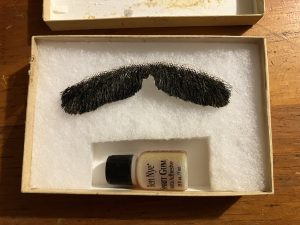
___________
Donelle goes to the New Museum’s Halloween benefit stark naked, but is turned away on the grounds that she must be in costume. She returns twenty minutes later doused in flour and wearing black gloves and shoes. “I still can’t let you in,” says security, “you’re supposed to be in costume!” “Can’t you see?” says Donelle, standing spread eagle, “I’m the five of spades.” [JG22101.392]
___________
Wallspace
619 West 27th Street
New York, NY 10001
tel. 212-594-9478
fax. 212-594-9805
info@wallspacegallery.com
Donelle Woolford: Dick jokes
February 21 – March 29, 2014
Preview: Friday, February 21, 6-8pm
Donelle Woolford’s cathartic new paintings, performance, and publication chronicle the dubious place of honor afforded the male sex organ in art and politics, and the vernacular tradition of penis humor in American popular culture.
Woolford’s joke paintings chronicle the picaresque adventures of a character named Richard—aka “Dick.” Who comes to mind when you see these letters:
R-I-C-H-A-R-D P-R
Richard Pryor or Richard Prince? Whichever one emerged from your subconscious, it placed you (and them) in one demographic to the exclusion of another. Richard Pryor was black. Richard Prince is white. Richard Pryor told jokes, Richard Prince painted jokes. Richard Pryor invented a racially explicit brand of comedy that, once begun, could not turn back, no matter how destructive it became. Richard Prince instigated the act of appropriation, a gesture that, once made, could not turn back, no matter how productive it became. Woolford’s Joke Paintings investigate this destruction/production dichotomy.
Formally the paintings continue her interest in artworks that “look like” known artists and styles, and the new works are indeed a thin gruel of Richard Prince, Albert Oehlen, and Christopher Wool. The paintings are placeholders, facsimiles, props. Even though the works embody painterly process and revision—evidence of the artist thinking out loud—in Woolford’s case all of the telltale signs have been figured out beforehand so that her skilled assistants can execute them by hand. Just as the humor of a joke is in the telling, the deadpan effect of Woolford’s paintings is in their execution.
Running concurrently to the exhibition and realized in cooperation with the Whitney Museum of American Art, New York, as part of the 2014 Biennial, Dick’s Last Stand is a 40-minute reenactment of the standup routine that Richard Pryor performed in 1977 for the last episode of his short-lived television show. The routine is a subversive work of social commentary that, by Pryor’s design, was censored from the final NBC broadcast. Consequently, Pryor’s standup has only ever been experienced by the 75+ people who were in the live studio audience that night. Dick’s Last Stand marks it’s return to the live stage, where its allegories on conformity, representation, subterfuge, and race are as painfully funny as ever.
Tour dates and venues for Dick’s Last Stand are:
1/30 LA Art Book Fair, Los Angeles, 6:30pm
2/2 Mandrake, Los Angeles, 9:00pm
2/6 Wattis Institute, San Francisco, 7:00pm
2/8 Solespace, Oakland, 8:00pm
2/14 MOCAD, Detroit, 8:00pm
2/18 Dorchester Projects, Chicago, 8:00pm
3/8 JACK, Brooklyn, 10:30pm
4/1 The Kitchen, New York, 7:00pm
5/20 Midway Contemporary Art, Minneapolis, 8:00pm
5/21 Duffy’s Pub, Lincoln, 8:00pm
5/22 White Flag Projects, St. Louis, 8:00pm
5/24 Contemporary Art Center, Peoria , 8:00pm
The paintings and performance are accompanied by Dick Jokes, an extraordinary volume of phallic humor compiled from throughout the United States over the past fifty years and available from McNally Jackson, Thingsthatfall.com, and the gallery.
For further information on the exhibition, the comedy tour Dick’s Last Stand, or for images, please contact Nichole Caruso: nichole@wallspacegallery.com.
* * *
Donelle Woolford (b. 1977/1980/1954 in Detroit, U.S.A.) lives and works in New York City, Brooklyn, The Bronx, Philadelphia, London, and Vienna. She has participated in the exhibitions Double Agent at the ICA London; The 8th Sharjah Biennial, United Arab Emirates; and the 5th Marrakech Biennial. Her performances have been staged at The Solomon R. Guggenheim Museum and the PRELUDE theatre festival, New York; The Lewis Center for the Arts, Princeton; The Suburban, Chicago; White Flag Projects, Saint Louis; and the Yale University Art Gallery, New Haven. She is a fictional character written by Joe Scanlan and performed by various actors in the scenery of the art world. Most recently she has been played by Abigail Ramsay and Jennifer Kidwell as part of the exhibition I Am Another World at the Akademie der Bildende Kunst, Vienna; and by Jennifer Kidwell solo in Dick’s Last Stand.
___________
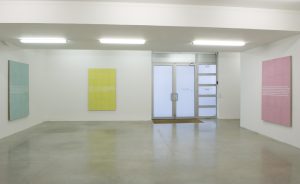
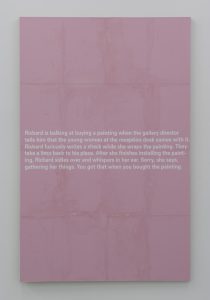
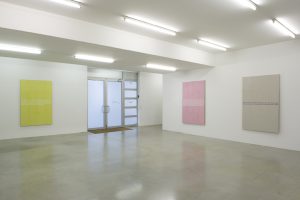
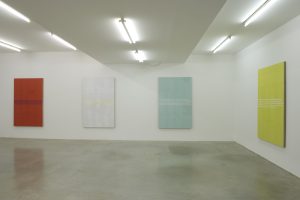
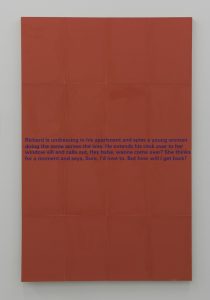
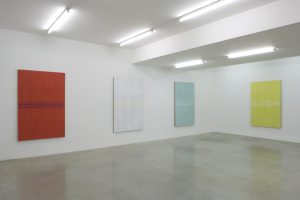
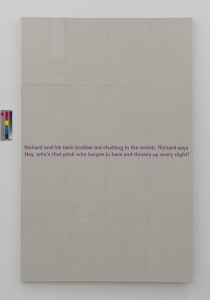
MaLeVoLeNcE, 2012. Installation views, Air de Paris, Paris
___________
Veritablement, Project Proposal
ARCO, Madrid, 2016
We wanted to make this show as a way of branding Donelle Woolford’s inauthenticity and selling it back to the public as part and parcel of her identity. Donelle, of course, is a fictional character, an “artist” who has “made” her own versions of Cubist paintings, Dan Graham performances, Richard Prince paintings, and a Richard Pryor standup routine. Woolford herself is performed by an array of professional actors, each one entrusted with the agency to interpret her character as they see fit.
Her new work is an edition of paintings, marquetry boxes, and recipes. As the story goes, after the controversial reaction to Donelle’s participation in the 2014 Whitney Biennial, she retreated to Marrakech to recharge her spirit and reconnect with herself. After spending some time there, however, she came to realize that, as an American raised on African American culture, she was no less a tourist in the fabled city than were the German, Canadian, and Japanese people wandering the markets and buying souvenirs. She began to fixate on the various trinkets and objects the local artisans produced for the tourist trade, and saw in them a reflection of herself: an exotic commodity fabricated for Western consumption.
She decided to roll with it: she published a book that outlined a pictorial narrative on the advent of Cubism, but printed in Marrakech. The book combined aspects of the beginning of the 20th Century — technology, botanical discoveries, African art, Western myths about the Other, modern medicine, Atlantic trade routes —as a kind of recipe for the advent of the Modern world. It was a cookbook, a social stew, one that Claude Levi-Strauss would be proud of. The Raw and the Cooked. But in Donelle’s retelling, which side of the Mediterranean was “raw?” Which side was “cooked?”
When she shared her book with her collaborator, Joe Scanlan, he agreed to publish it in a limited edition as part of the 5th Marrakech Biennale. However, as an inversion of the accepted notion of who has influenced whom between Europe and Africa, Scanlan arranged to have the workers at the Marrakech printing house interleave the book with handwritten recipes. The material producers of the edition disrupted the content of the edition by inserting their voice and sustenance into its narrative.
Back in the Bronx, Scanlan and Woolford took things one step further. Scanlan impersonated both Woolford’s brand of Cubism and the vernacular of Marrakech artisans by making a series of marquetry recipe boxes as containers for Woolford’s book. There are thirty-five boxes, each one unique and each one representing one of Woolford’s cubist paintings. For Woolford’s part, she scanned the handwritten recipes, enlarged and digitally altered them, and then printed them out as paintings, the blot and streak of Arabic written in ballpoint pen drained of their touch and spontaneity.
Neither the marquetry boxes, nor their inlaid images, nor the recipe paintings, nor Woolford’s cubism are authentic. The entire project is a hall of mirrors with no origin, a mise-en-abyme of facsimiles. Nonetheless, all of them are very real.
Véritablement.

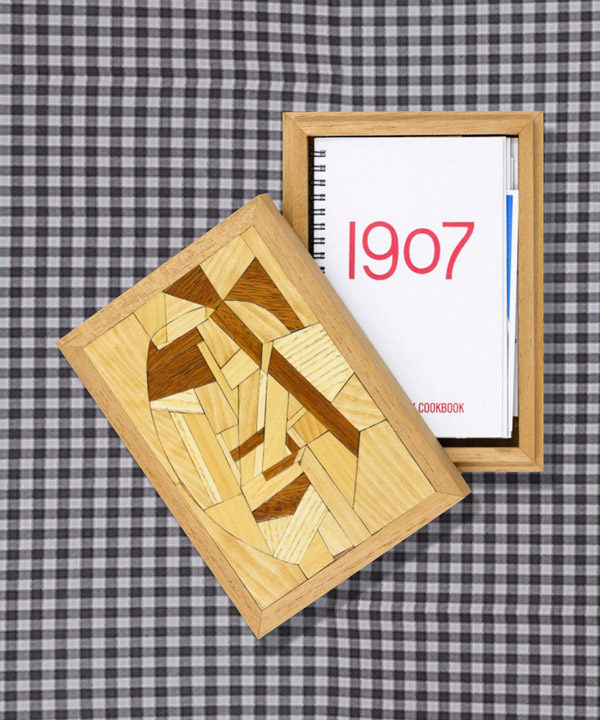

___________
A Discussion with Donelle Woolford ICA, London
16 March 2008
with Mark Sladen, director of the ICA, and Claire Bishop, art historian
(with apologies to Gertrude Stein, a version of this text in the form of a script is here)
MARK SLADEN: This discussion obviously coincides with the Double Agent exhibition, now on view at the ICA. It has been curated by Claire Bishop, a writer and academic, and Associate Professor of History of Art at Warwick University, in collaboration with myself, Mark Sladen. I’m the Director of Exhibitions here at the ICA. We’re also delighted to have here with us this afternoon Donelle Woolford, who is one of the artists in the exhibition. Donelle is an artist from New York who has exhibited in a number of international group exhibitions such as last year’s Sharjah Biennial in the United Arab Emirates. She’s represented by Wallspace in New York and there is a bit of extra information on her in the gallery guide to the exhibition.
One of the central concerns of Double Agent is the use of mediation, delegation, and collaboration in contemporary art practice, and Donelle is here at the invitation of the artist Joe Scanlan. She is currently in residence in a temporary studio, which you’ve probably seen downstairs, where she’s making sculptures; she’s here on Saturday and Sunday afternoons. She’s going to give a fifteen-minute presentation on her work that will be followed by a half-hour-long discussion between the three of us, in which Claire and I will attempt to situate Donelle’s practice within the wider themes of performance and authorship in the exhibition, and then we’ll take questions. I imagine the whole thing will probably last about an hour. But let’s start with your presentation, Donelle.
DONELLE WOOLFORD: Good afternoon. Thank you for coming today to hear me talk about my work. First I want to thank Claire and Mark for inviting me to participate in Double Agent. It’s been a great adventure to be a resident here and a fascinating experience for me to create work in a public venue.
Okay, so: Donelle Woolford: Exhibition Views.
[Image 1]
Last year I participated in the 8th Sharjah Biennial in the United Arab Emirates, and as in the exhibition downstairs the installation I presented was a remake of my studio. You can see here—just like downstairs—that I work at two desks, and I have wood. I inhabited this studio during the opening, which was an all-day affair. What was interesting here was that all of this wood was actually taken from a working studio in Sharjah. During the time that I was there I did a little research on the city and I found that the Sheikh had decided to kick out the people who were working in the middle of Sharjah and make it into a kind of historical village, a fake antiquated town in place of the real one. All this wood was from a carpenter’s studio that was no longer being used. And it had me ask the question: What is real if this town is filled with actors —like in Virginia, where we have something called Colonial Williamsburg. What is real, if the workers are no longer involved but actors are called in to play them? So I decided to make a fake studio in the middle of the museum and use the wood from this real studio that was deemed useless.
[Image 2]
So, facing this studio is your usual gallery scene and it has my works on the wall, and that also begged the question, for me, of what is this space? What are we looking at? When you walk into a museum is this what you expect, or is it the space where the art is actually created? And for me it’s important to have both sides of the table shown: the messy side that actually brings about the beauty on the pristine side. And I like the confusion that generates, how sometimes being presented with a view backstage is more interesting than what’s on stage.
[Image 3]
That’s me in my studio. Ah, yes. This… [laughs] This is when I met the Sheikh. And it’s interesting because this picture captures a moment that I don’t really remember … partly because I can’t remember what was going through my head, just ‘I’m meeting a Sheikh! This is unbelievable!’ And so you have your blinders on, like, ‘Ah! This is amazing!’ But then I see the picture and it’s funny to me because he really doesn’t look like he’s interested! He’s the one in the middle, and next to him is his son, and then we have the two attendants on either side and they crack me up because they really—honestly—look like they’re happy to meet me. And I read someplace that UNESCO calls Sharjah the cultural capital of the Middle East, and, you know, it’s true he’s really done a lot to bring art into the community. Whereas a lot of the other states there are associated with gambling and things like that, he’s maintained Sharjah as a dry state and really, you know, about art. So that was me meeting a Sheikh!
[Image 4]
Okay, this is in Paris, at Galerie Chez Valentin. This exhibition wasn’t a recreation of my studio. It was actually more the kind of scene you expect when you walk into a gallery. I tend to use palm trees in my work, partly as a screen, so to say, like camouflage, and in this particular instance I added some modern chairs as well.
[Image 5]
And with this view you can see better how the palm trees are acting as a screen but how also, with the chairs, they act as brackets to my paintings. And I guess to just mention a little bit about my work, the time period that I am influenced by mostly is the early twentieth-century, with the birth of the Cubist movement and the use of African masks, and how painters at that time were influenced by seeing these so-called ‘primitive’ aesthetics. So, for me, palm trees are a kind of camouflage, but they also function as a sign of the exotic, the Other, in relation to my work.
Additionally, trees have been around much longer than we have, well at least longer than painting and art and Cubism as we know it, and modern chairs come after that movement, so they do kind of frame my work in that way. They stand in for any number of tensions that were in the air at the time and perhaps contributed to the birth of Cubism, conflicts that might be summarized as Paul Gauguin versus the Wright Brothers. And lastly, and this is something that we just don’t pay attention to a lot of the time: When you walk into galleries or loft spaces that are kind of stylish there are often palm trees, and they’re almost irrelevant because they’re not natural to the spaces where they are, they’re not indigenous trees. So that’s another reason why I use them in my work.
[Image 6]
This show was at the beginning of this year in my native New York, at Wallspace, which is located in Chelsea. And this is again a very traditional gallery view. My work is on the wall again and I have the plant, not a tree this time but another very luscious, exotic plant, as you can see, a philodendron. Wallspace is a gorgeous gallery.
[Image 7]
Now adjacent to this larger room is a smaller back room in which I made a kind of collage in space. And what I wanted was to have each of the objects that make up the collage consist of an
exclusive material, each with exclusive properties and a distinct role to play. So there is fabric on the chair, and the steel armature, and wood, a plant with its particular elements —chlorophyll, soil, cellulose, the plastic pot—Plexiglas, a Malinese stool, an incandescent floor lamp, the digital projector, and, on the ceiling, a grow light. I kind of saw this as the boiler room for the main gallery.
[Image 8]
And the projector, you’ll see better here, projected different images from 1907, which is the year that Picasso painted Demoiselles D’Avignon. For example, we have different African art and artefacts but also technology from that period. And all of this I did with a variety of research, some in-depth and some superficial, from reading Robert Rosenblum’s Pioneering Cubism to doing Google searches on the Internet. And so that included automobiles from that time, early airplanes, and some documentation of plants from Africa that were discovered and catalogued by the museum of natural history in Paris. And also fashion: late Victorian capes, what men and women were wearing at that time. The way I see it, it was almost as if this was a primordial soup waiting for lightning to strike it and touch off the Cubist movement. Who knows, probably not, but at least it was all there, all the ingredients were there.
[Image 9]
And so the next one is here. If you haven’t seen the space downstairs, this is my studio again recreated. Every day I walk in there I wish my actual studio looked like this (laughs). I want to take the view back with me to New York; it’s such a beautiful building. And I have two worktables and various tools that I would use as I do my work. And if you’ve seen me here, you’d see that I actually have been constructing pieces while I’ve been here.
[Image 10]
This is another angle. Something that’s not shown is that I have a nice couch—which everyone’s welcome to sit on, and people have been sitting on—but it’s something that didn’t appear in the Sharjah Biennial. It really is representational of my time in the studio, because I don’t necessarily spend most of my time making things. A lot of times I’m just dreaming or sketching or something where I need to take that time out and really recoup and figure out what the next step is.
[Image 11]
And this is the corner where I or someone who’s interested in my work could come and check out what I’ve made and just get a sense, away from the space, you know, what pieces might look like in a gallery setting. And there’s my plant—even though I make that statement, I still like to have them around. They are beautiful.
[Image 12]
Oh, this is opening night! And that’s Natasha from the marketing office. Yeah. It was a great night. People kept slipping beers in. It was a fantastic night for me, I loved it.
[Image 13]
And just some of my works. Okay, Still Life With A Hanging Lamp. Again, as you can see, most of my work is with wood.
[Image 14]
And this is Tabula Rasa, which of course means blank slate. [Image 15]
And this is Detonation. This piece always reminds me of musical instruments exploding—hence the title. Because with an explosion you have a detonation but also when you explode instruments they become de-toned, so it’s kind of a pun. And this is Sharette, which is downstairs; a sharette is a space, usually an architecture office, where many people are working side by side in the same room under the watchful eye of a supervisor or a ‘master’, so I think it was very appropriate for this review. Plus, it’s an old-fashioned word, it makes you think of rows of drafting tables and hanging lamps and precision drawing instruments, and I like that image.
CLAIRE BISHOP: OK.
DW: I hope I didn’t fly through that out of nerves!
CB: No, no. That was great. Thank you very much, Donelle, for that presentation. I know that you’re participating in this exhibition on the invitation of Joe Scanlan. I wondered if you could you just clarify what your relationship is to Joe.
DW: Well I’ve known Joe for many years. He was my first sculpture teacher at Yale, and for a little while afterwards I worked as his assistant.
MS: And was that a useful experience?
DW: Well, actually it was a great experience and great practice for becoming an artist. And it also allowed me to bide my time and see how things worked because I couldn’t quite figure out how to insert myself in the art world. I guess in the beginning for me it just seemed very difficult as an unconnected, unknown artist from the South, and a black female in a predominantly white male environment. How could I make it happen? So originally what I planned to do was make myself invisible and don a mask and I started to pawn off my works under someone else. And after a while I just realised that being invisible was ridiculous, you know, with Joe promoting my works. First of all he’s getting all the credit, but, as in any situation, you know, being an assistant you eventually want to break out on your own. And so I did and I pushed Donelle Woolford out there so she had her own space, her own work, and her own narrative.
CB: So is that what you think you’ve been doing over the last year or so, inserting yourself into the art world by showing your work in studio installation format in Sharjah and here at the ICA?
DW: Yeah, yeah. I think every young artist is a character ready to be consumed. You know when people see me they don’t know if I’m real or not, but for me, perception is relative, I don’t care if people think I’m a collaborator or an avatar or an actor.
MS: So then what or who do you think you are?
DW: Well, today I am Donelle Woolford. [Laughs] Because I choose to be! That’s my mantra. And I’m fascinated by authenticity or the lack thereof: Who’s to say what’s real or a performance? We all show different sides of ourselves and we all hide different sides of ourselves, and we choose an image based on other images and basically—like P. Diddy, Puff Daddy, or Sean Puffy Combs, or whatever he wants to be called now—it’s just that: it’s just a name and that’s not what really matters. What really matters is how you put yourself out there. And that’s what I’m
doing: I’m putting Donelle Woolford out there with strength, with conviction, and with confidence. Oh, and, by the way, my name is Abigail Ramsay and I’m an actor that was hired by Joe Scanlan to play the role of Donelle Woolford, just as other actors have been hired to play her in different locations.
CB: So Abigail, if I can call you Abigail, what’s it like playing the role of a contemporary artist? Is it frustrating or exhilarating or testing?
DW: [Laughs] It’s actually a lot of fun! I’ve had nothing but a great time doing this and being here and meeting people. It’s been utterly fascinating to have a space in this museum and have people come up to you as an artist, expecting you to be an artist, and I guess almost like the awe that you get and the good wishes. It’s been amazing and I’ve loved every moment of it.
CB: I’m curious to find out what kind of directions Joe Scanlan gave you for performing Donelle?
DW: Joe was fantastic, actually. We had, I guess, to set it up we had a very brief time, less than a month from when I got the role to when I came here. So it was a crash course in art. He sent me a long e-mail talking about different types of art like appropriation, collage, narrative art, identity art. He gave me different readings I had to do and different shows to attend. Unfortunately, I did miss the Robert Prince—
CB: Richard Prince.
DW: —Thank you, the Richard Prince retrospective that was at the Guggenheim. But I did catch the Kara Walker exhibit, which was a beautiful example of I think it was identity art. And then we had a great field trip to the Met to look at their African art collection, which is extensive, and Joe came along and we just went through that and then saw a little bit of the works from Picasso and people of that time.
MS: Could you talk a little bit about the audition process? I also understand Joe has particular ideas about styling you as well.
DW: Yes, yes. Well, the audition process was [Laughs] pretty fascinating. When I saw the ad I saw they wanted someone who knew a lot about art, and I was like, ‘Oh no! I’m not gonna do
this! I know nothing about it’. And then I eventually went, and each time I went I had to say something about art and I really thought I was making a fool of myself. But he’s been very good at giving me a lot of information and honing what makes sense to people. So for my final audition I had to go to, I forget what it’s called, but it’s when critics come to your studio and grill you on your work. So I had a kind of mock set up of that and out of the whole experience I think that was the hardest thing that I had to do—though this comes close! But, you know, it’s been very eye opening and he’s been very patient with me through the whole thing. And as for styling he’s very much into the image of what I look like and so, like, this jacket, which is Dries Van Noten, I’ve never heard of him in my life, but this was something that was very important that I should wear, as well as my fifteen-dollar glasses that I can’t see out of at all [Laughs] and my shoes, so this has been my uniform which has been very helpful in forming my character.
MS: And can you say a little about your experience here at the ICA? I should add that one of the instructions that Joe gave us was to take Donelle out and insert her into other art world situations in London. So maybe you could say a bit about your experience in the gallery and also outside?
DW: Well, my experience here has been great. People here have been really, really kind. There have been a few times that… well, everyone has that gallery guide and clearly that woman is not me! [Laughs] It’s been interesting dealing with it: from hearing that I’ve gained a lot of weight [Laughs] to people staring at it and staring at me for a while in the corner, and then finally coming up to me and saying, ‘Are you the artist?’ and I say, ‘Yeah!’ and they say, ‘Oh, yeah, of course, of course, yeah’—so that’s been kind of fun. But for the most part people have been very generous and I’ve really enjoyed my time. And I went out with Mark a few times and it was like going out with a rock star I have to say. I loved it! [Laughs] But of the different events that I’ve been to, I think the most fun was going out to the dinner with—
MS: —we went to a dinner at White Cube for the opening for Mario Garcia Torres’s show. I thought this might be a good one to go to as some of you might have seen the lecture that he gave at Frieze last year that was also about using the idea of a fictional author. I called up White Cube in advance and spilled the beans about who she was, and then it became a fascinating dynamic over dinner—people who knew and didn’t know—and it played itself out in a very interesting way.
Whereas other situations we’ve been in, like going to the Derek Jarman opening at the Serpentine, one just felt that any edge the project might have just got lost in that sea of people. But I was corresponding with Joe and he thought that was quite good because it was a classic situation for a young artist to be in, lost in an ocean of gamesmanship and activity.
CB: Can I ask about the difference between taking instructions from an artist and taking instructions from a theatre director?
DW: You know, it’s interesting because the two don’t exist in the same world. From a theatre director you have the script and that informs you first and foremost—what and who your character is. By contrast, in this environment your character becomes… how does Joe see it? How do I see it? Who’s this woman? How did the last woman play it? Whereas in theatre, a director shapes something that already exists and we all have an understanding of the characters in a play and how the play unfolds. With this situation it was very improvisational and we never quite knew what was going to happen next. The best advice that he gave me was to ask myself, when I look at a work, and particularly when I look at my work, how does it hit me here, how do I feel about it? Not what do I think of the history, or how do I think about it politically (which is how I was approaching it before), but what it actually feels like here when I look at it. And that always brings me back to the idea that, okay, I inhabit this role.
MS: And do you think his idea of Donelle Woolford and yours are very different?
DW: You know, he gave me carte blanche, I have to say [Laughs]. He really did. I think a great example is the fact that in the guide it says I’m from Conyers and then another place it says I’m from Cleveland, and then he says, ‘It’s okay, just say you’re from New York’. So other than ‘This is what she wears’, he never said this is the way she acts in this situation, he left that up to me.
MS: Because she’s changed, hasn’t she? She has got older for instance and not just chronologically. I mean in previous outings Donelle was in her early twenties and now she’s supposed to be a little older than that.
CB: I think it’s also telling that Joe is an artist and not a theatre director and the emphasis is on the visuality of Donelle: What she’s wearing is important, how she looks in the space and what the space looks like that she’s operating in. There’s much less emphasis on motivation for the character.
DW: That’s a very interesting point. Yeah, I mean, he did say, ‘think about if you were in a situation that was tough, how would you react?’ But for the most part it was what I looked like. And I have to say, the uniform came very late in the process. A lot of my groundwork was actually going to museums and meeting people and just finding out a lot about art.
MS: One thing I’ve always assumed about this project is that there’s an element of satire in it; there’s a satire of political correctness of the art world, there’s a satire of the cult of youth in the art world. What’s your opinion about how ethnicity and gender come into this role and do you think your understanding of its dynamic in those areas is different from Joe’s?
CB: I should add that Joe Scanlan is a white male artist and Donelle Woolford is a black female artist.
DW: We never really spoke about that. I think it’s one of those things that some people look at and see, as opposed to me experiencing it. And I think it wasn’t my business to worry about that. My concerns were creating a human being, reacting in a way that was human, and being a character that people understood. So the politics is a difficult question because it takes me out of the character. But I remember not wanting to tell my friends who are very political that I was doing it. But when I did eventually tell them they all thought that it was great that I was going out and getting the chance to play a character that is potentially full and in an exotic location. So it reminds me of Hattie McDaniels in Gone with the Wind: She won the Oscar playing—I can’t remember the character, but she was the mammie role—and she got a lot of flack for doing that. She always said that she preferred making $70,000 for playing a maid instead of $7 for being one. And I think there’s a point where people make that decision for themselves—that it can’t be about the political experience, but rather it has to be about your human experience.
MS: I think now we’re going to snake away into a more general discussion about the show as whole. And one thing I wanted to bring up with Claire is how you think Donelle relates to the issues around performance that we wanted to explore in the show as a whole.
CB: One of the premises of this show, which forms part of my research for a book I’m writing, concerns a difference in performance art from the late sixties and early seventies and what’s happened in the last ten or fifteen years. In the earlier paradigm, artists used their own bodies in body and performance art. Their own body is the site of authenticity and meaning; they act upon their own bodies as material and medium. In the last ten to fifteen years we’ve seen a notable shift
away from this paradigm towards artists ‘outsourcing’ or delegating this work of performance to other people. This was an operation that I wanted to explore through a number of contemporary practices, to look at the ways in which this displacement of authorship takes place in performance but also through other mediums such as video, film, ceramics (in the case of Paweł Althamer), and installation (in the case of Donelle). That’s why these people have been assembled in the ICA in this particular way.
I’ve had a number of reactions to this exhibition, both in the press and from people talking with me, that assumed it relates to my previous writing about relational aesthetics and participation. But it doesn’t at all; for me this is a completely separate issue. Double Agent is not about viewer interactivity but about a mechanism of delegation, of outsourcing performance to other people.
Something that does connect it to my previous writing is an interest in works of art and projects that are ethically uncomfortable, rather than a model I’ve criticized in the past (particularly in relationship to relational aesthetics) that presupposes a harmonious community of respect and understanding and togetherness. I’m more interested in projects that are barbed in some way, and I think that the satirical element that Mark has pointed to in the Donelle Woolford project picks up on that: There are moments of discomfort for both the actress who’s playing Donelle and the audience. On the opening night, a lot of people were completely convinced that this was an artist who had set up a studio in the space. So there’s an element of deception there that’s more or less convincing and more or less troubling.
MS: And as well as this notion of delegated performance there are also a lot of questions around authorship that the exhibition brings up, specifically around unreliable narrators. There are a few projects which have fictive authors: Donelle is one, but the Barbara Visser film downstairs also involves multiple layers of deception. We wanted to do seven quite distinct projects to show different aspects of this field. I even think someone like Paweł Althamer is an unreliable author within his own work. He’s quite unplaceable within the Nowolipie Group, for instance. I wondered if you could say something more about that.
CB: Okay, it’s tricky to talk about Paweł specifically. Something I’ve become aware of since the show has gone up is that although displaced authorship seems to be a theme within many of these works, the idea that the authorship is entirely removed in them is misleading because in fact there is a very strong sense of authorship behind each of these projects. That’s what makes the best of them compelling: There’s an openness that takes place within a highly controlled framework.
AUDIENCE MEMBER 1 [Polly Staple]: Can I ask a question? Can you just say a bit more about that?
CB: Yes, okay. This is something I’m trying to wrestle with and articulate at the moment. Some of the art of the present decade that interests me most involves an artist who has set up a particular structure within which they can anticipate what will take place—but it’s not tightly controlled or directed. So the works by Paweł and Artur Żmijewski are both classic examples of this, and come out of the way in which they were taught by Grzegorz Kowalski at the Warsaw Art Academy in the early nineties. He had an experimental way of teaching that was based around the idea of ‘open form’—which was opposed to ‘closed form’, i.e. structures and situations that allow no space for the viewer’s participation. This meant that his teaching involved setting up the rules of a game, but how the action by the individual artists unfolded was subject to enormous variation.
And I can see both Żmijewski and Althamer using that technique in their works in Double Agent: setting up a structure and then watching it unfold. You can see that very clearly in Żmijewski’s Them, in which he sets up a series of combative painting workshops with four groups that have disparate ideologies. To an extent you know that he knows the outcome is going to be complete nihilistic conflagration, but he has no specific control over what people are saying or how they are going to react in that context. Does that make sense?
PS: Yeah. I’ve got some questions, but shall I wait until the end?
MS: Let’s throw it open.
PS: All the way though this discussion, my desire as an audience member is to know what’s at stake with Joe Scanlan with this piece. Who is Joe Scanlan? And what does it mean to him in terms of artistic strategy to develop this project? Even though I also am very aware of an unreliable director and know what’s going on with the piece, I still—
CB: You still want to pin it on an author and find out their intention?
PS: Yes, which is why I’m suggesting that what the piece builds up is… As much as exploding myths about authorship it also reinforces them by mythologizing Joe Scanlan. I know Joe Scanlan is a real artist. So that’s interesting to me and I almost want Joe Scanlan to be on stage as well.
MS: I was looking through my correspondence this morning and I found this rather interesting quote that Joe made about Donelle. He said: “She’s a full-fledged artist in her own right: she has right: she has a body and opinions and a developing oeuvre. Her only drawback is that by conventional measures she is not real. My role is that I invented her, just like any other author who invents a character whom they hope will enter the public imagination. I guess the big difference is that unlike a character within the framework of a novel or play that has a beginning, middle, and end, Donelle is not fixed. Rather her character is still unfolding, still being written, even as she moves through the stage of the art world, with all its characters and props. I am also on stage, partially hidden behind the bookcase or potted palm, furiously making scenes and lines and props to hand to her just before she needs them.”
CB: What I was dreading at the last talk I did here was somebody buying the whole situation as we’d presented it to them and asking me, “Well, why did you invite Joe Scanlan in the first place? Surely there was something about his work that fit within the context of this show that he then delegated to Donelle Woolford.” And I wouldn’t be able to answer that because I think this project stands at a distance from his other work.
PS: That would be one of my questions as well, if Joe Scanlan were on stage. At what point did he decide to develop the Donelle Woolford project and how does that relate to his other work? And also where does the Donelle Woolford project go? Because there must be a saturation point when it doesn’t work anymore because everyone knows how it works. So it’s like the Pierre Huyghe Ann Lee character—there’s a ceremonial killing off. I suppose what I’m intrigued about is a wider story as to why this trend?
CB: I’ve raised this question with a few people who write about theatre and performance and they support my use of the word ‘outsourced’ because it connects to economic changes that took place in the nineties regarding the outsourcing or offshoring of labor. I’ve realized there are many words we can use to describe this mechanism, but outsourcing evokes an era of flexible working systems and economic globalization. I don’t yet know to what extent artistic practice dovetails with those trends or is critical of them, but I think it’s significant that they are contemporaneous with these shifts.
MS: Could we take some more questions? Or we’ll go back to Polly. Any questions about any of the pieces?
AUDIENCE MEMBER 2: What would happen if we’d just carried on sitting here and the exposure hadn’t occurred? What if we didn’t know, and assumed we’d just got a fattened up version of Donelle sitting there. Why expose?
MS: I think it becomes more interesting in a controlled exposure of Donelle. At least that’s been my experience.
AUDIENCE MEMBER 3: If people remain in pig ignorance then?
MS: People in the art world are incredibly trusting. It’s a very nice, consensual environment and I was initially rather disappointed by how straight everyone took Donelle, that no one was really questioning it. So at that point I started to tell a few people, just to try to get a rumor circulating, and I think that the project becomes most interesting when it starts to break down. If it’s a flawless façade then I don’t think it operates.
CB: But tell me how you experienced the first half of this talk. Would you like more discussion about wooden Cubist assemblages?
AUDIENCE MEMBER 3: Well there was something about these introductions—the Arabs, they certainly looked real, were they real?
DW: It was, yes. They were.
AUDIENCE MEMBER 3: I mean, does this place actually exist?
DW: Yeah! Sharjah.
AUDIENCE MEMBER 3: So somebody, not necessarily you, someone went there, a previous artist?
CB: Donelle went there. OK, anyone else?
AUDIENCE MEMBER 4: I have a question for Abigail. How much do you think you actually become the artist in the piece? If you’re left without a script, you become the only creator of the piece. You might not be a visual artist but as a performer you step into that role and take over that part and Joe steps back.
DW: Well, yeah, because Joe’s not here, so the reactions have to come from me and I suppose if I’ve been doing it for five years then I could definitely say, ‘This is where Donelle is stepping forward’. But doing it for about two months, you know, she’s not a different person from myself, and she can’t be because I’d be second guessing every move I made.
MS: I should also say that the exhibition is going to tour to two other venues: the Mead Gallery in Warwick Arts Centre and the Baltic Centre for Contemporary Art in Gateshead. And there are other actresses or agents playing Donelle, some of whom may be with us this afternoon.
AUDIENCE MEMBER 5: I’m not even sure if the original character of the artist exists, does she? Or is she completely fictitious?
CB: What do you mean the original character: Joe Scanlan or Donelle Woolford? Audience member: Donelle Woolford. Does she actually exist in her own right?
CB: Donelle exists.
AUDIENCE MEMBER 6: So Abi, have you ever met her?
DW: I guess I’ve met her through her work. I’ve met her through Joe. She’s not a body to meet. She exists, but…
AUDIENCE MEMBER 6: Is she just an idea?
CB: I think the thing that Mark read out from Joe is beautiful, and that it says it all. MS: Any more questions that we can dodge?
AUDIENCE MEMBER 6: Did you say you’re not worried about ethics?
CB: Okay, this obviously needs a little bit of refining. It’s clear that ethics and politics come into any artistic judgement. What I meant is that I’m critical of liberal humanist ethical positions that have re-emerged in philosophical and literary thinking since the nineties under the pressure of identity politics and political correctness. And I’m more interested in retrieving theoretical anti-humanism from the French ‘68 tradition. The recent writing of Badiou, Ranciere, and Żizek is where I would align myself with regard to contemporary ethics rather than with the diluted forms of Levinas that concern responsibility and respect and acknowledgment of the Other. Does that make sense?
PS: So you think a defining feature of the post–relational aesthetics moment is antagonism? I’m thinking of that in relation to Chantal Mouffe, who you mentioned in your article.
CB: Yes, I did use antagonism as a way of criticizing relational aesthetics, but I wouldn’t want to turn it into an operative principle to describe all contemporary art. I think some people would like me to do that but I’m a bit resistant to it.
AUDIENCE MEMBER 7: Can I go back one step to the unreliability of the narrator? Ultimately, if that is built into Donelle’s character, then it only functions to the point of revelation. I’m only coming across this fresh today. I thought I was coming to a curators’ talk, so is the fraudulence built into your manner or the frame?
CB: I’m not quite clear what you’re asking.
AUDIENCE MEMBER 8: This afternoon during the talk you made a revelation. And is that built into the presentation of the character when you’re not making that explicit revelation? I mean for me as an audience member visiting downstairs…
CB: Well, some people read the gallery guide very astutely and pick up on it by making the links from Dora García to Barbara Visser and then coming upstairs and they completely understand. It’s also hinted at through the tone of our language in the gallery guide: last weekend somebody drew my attention to one phrase, ‘up and coming’, which we would never use in relation to the other artists.
MS: That came from the press officer who wrote the press release. I was going to delete that phrase but then I decided to leave it in because it’s slightly destabilizing: If people are looking out for clues I think that is a clue. And there are other clues in there, when I described this talk I wrote that Donelle was going to talk about her ‘double life in London’. And I think Joe does seed discrepancies into the project—for instance about Donelle’s age—you could probably Google her and find several different birth dates for her on the web if you really had the time.
AUDIENCE MEMBER 9: What is Joe’s previous work about?
CB: He’s primarily a sculptor. The work concerns economic systems and the circulation of goods not just within the art market but also within a broader market arena. He’s got a very good website called thingsthatfall.com; for example, one of his projects is artist-designed coffins that you can buy, and the web pages take you through a whole Amazon-style shopping-basket mechanism to have the work shipped to you.
AUDIENCE MEMBER 9: Is it possible that Joe Scanlan is actually here?
MS: I like the way that everyone is becoming less trusting. I think if we wanted to achieve one thing with this exhibition we’ve done it.
AUDIENCE MEMBER 9: Could it be that Joe Scanlan is not a white male at all, but a white female, or the curator?
MS: We did think about having a third fictional curator for the show.
PS: One more question. Do you know if, when Joe Scanlan is invited to talk about his own work, at another institution, not necessarily in conjunction with a show, do you know whether he talks about this project?
CB: No, I don’t know that. But certainly on his website Donelle Woolford is one of many projects you can click onto, so you can easily source it as his work. But I don’t know what he says in an artist-talk situation.
MS: Maybe one more question before we wrap up?
CB: There’s one more thing that Joe wanted me to ask Donelle: As an outsider functioning within this gallery but outside the art world, what behavior or mannerisms have you observed while looking at the art world? What did you find that you needed to incorporate into your character to become more convincing?
DW: I used the word generous before to describe the audience but I think a lot of artists that I’ve come across are generous in a very soft way. It’s just so delicate, very welcoming. It’s so hard to describe and I feel really almost foolish saying it but there is something that’s just very open that I really appreciate compared to coming across a group of actors, which can be a little in-your-face sometimes.
PS: One last question. It’s about the desires of the institution. I was foxed, but when I received the invitation card for the show it was also the point when I became suspicious of the project. I suddenly thought, ‘I can’t believe it, the ICA are promoting this show with this extremely good looking young black woman artist I’d never heard of – they’ve gone and found some girl in New York’. But that also dovetailed with my understanding of the ICA wanting to promote itself to a kind of young and hip audience.
CB: That is such a great point. I would be deeply suspicious if I received an invitation card with that image: We’re not been shown the artist’s work but we’re being shown the artist bending over a desk with her bum out in these little cute shorts.
PS: I’d be curious to know at what point you chose that image.
MS: It was when we realized that part of Joe’s desire was to disseminate images of Donelle that I thought that the card would be a good vehicle for that.
CB: Joe is interested in her also being a virtual avatar around London. So that even when Abigail is commuting from Chiswick to the ICA, it’s a theatre without a frame: some people are seeing Donelle but they don’t even know she’s Donelle. And one way in which to seed that idea is to have her on the publicity material of the exhibition.
PS: Your point about the visuality is really interesting. Because even though Abigail is really good, it’s the moment when the visuality starts to creep in, with that card, that’s really powerful.
MS: Well, unless there are any questions that anyone is dying to ask, let’s wrap it up.
AUDIENCE MEMBER 10: Why have you revealed it at all, so some people would know and some people wouldn’t? Why even expose it, why not just allow some phrases within notes to allow people to pick up on it?
MS: Well, we should probably say that the middle section of the event, after Abigail gave the PowerPoint presentation, the first few questions were actually scripted by Joe from an interview with Donelle that was partly written by Raimundas Malasaukas. So you could say it was his decision to reveal her because we were reading from a script that he conceived.
CB: But I like the way it’s generated more doubt about Joe’s identity. This is for me the most productive part of the day.
___________

___________
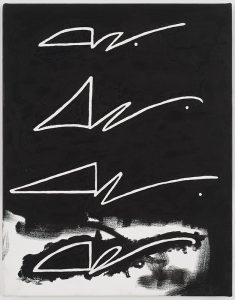
___________
However radical your message is as an artist, you are doing it through self-expression—the central dominant ideology of modern capitalism. And by doing that, you’re actually far from questioning the monster and pulling the monster down. You’re feeding the monster. Because the more people come to believe that self-expression is the end of everything, the more the modern system of power becomes stronger, not weaker.
I sometimes wonder whether the very idea of self-expression might be the rigid conformity of our age. It might be preventing us from seeing really radical and different ideas that are sitting out on the margins—different ideas about what real freedom is, that have little to do with our present day fetishization of the self. The problem with today’s art is that far from revealing those new ideas to us, it may be actually stopping us from seeing them.
—Adam Curtis , UK filmmaker