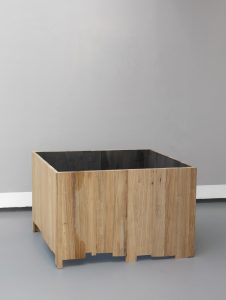
DIY
Artist’s Curate: DIY
Although many artists can be said to contemplate mortality in their work—usually in a veiled, Robert Frost kind of way—a clearheaded few have cut through the allusive haze and made their contemplation plain. Whether natural selection, mercy killing, or suicide, intimations of death have gotten artists through many a hard night. Sensing her failing beauty and waning political influence, the Countess Castiglione posed for The Foot, one of her most touching and sardonic images. Kazimir Malevich designed and painted his own coffin without compromising his aesthetics or his politics. This austere Suprematist box suggests that the beauty of having a formal ideology is that you can take it with you.
Staging death has also been an effective way for artists to express a wish, foment resistance, or change careers. They have posited death in the form of crystalline inertia (Robert Smithson), weightless dispersion (Andy Warhol), theatrical entombment (Paul Thek), subterranean surveillance (Bruce Nauman), ritualized grief (Gordon Matta-Clark), or delusional grandeur (Bas Jan Ader). For each of these artist, the metaphor of death promised a subversive alternative to the equally fatal obligation of producing yet another signature work.
Today, artists no longer face this dilemma between their integrity and the demands of the culture industry. In fact, making reliable works of art now requires that artists sacrifice themselves as beautifully as possible. General Idea served up giant placebos of themselves, David Hammons masters kicking the bucket, and Maurizio Cattelan digs a grave just as he is becoming a star. In a time when art gets subjected to the same numbing cost analyses as IKEA shelving units, a little death homeopathically injected into the system might be just what our culture needs.
First published in Artforum (Feb, 2004): 133-39
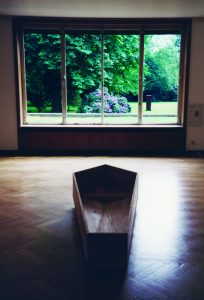
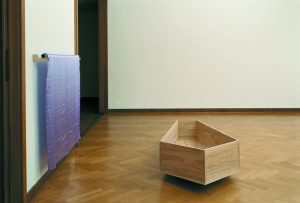
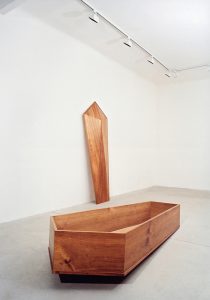
Do It
1. Bring your body into proximity with an object or material in such a way as to be able to kill yourself.
2. Kill yourself.
3. Repeat as necessary.
First published in Do It, Hans-Ulrich Obrist, ed. Revolver: Frankfurt am Main, 2005: 318.
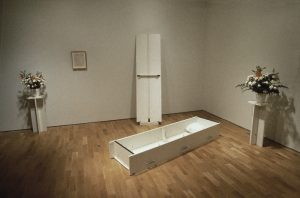
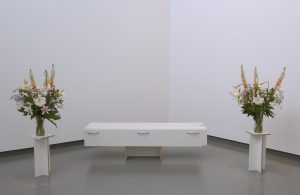
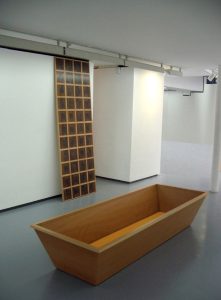
THE UNDERTAKER’S ART
a 4-part television series
THE SET
The set will require: two chairs (arranged side by side but angled slightly towards each other, like on a typical talk show); one body-length table on wheels, preferably stainless steel, draped with a clean white cloth; one coffin; one low catafalque (coffin stand)
THE PROPS
The host (Joe) needs no special props. He will be seated stage left. The artist (Pierre) will need one fake Hollywood knife, the kind that emits a red liquid when you “cut” with it. He will also need the tools of his trade and perhaps two technicians with whom he is comfortable working–otherwise, museum technicians will do. He will be seated stage right. Wardrobe should be comfortable but slightly formal, a mix of funereal sobriety and talk show panache. Prada or Helmut Lang would be best.
SHOW 1
[camera frontal and stationary]
JOE
Hello, this is Joe Scanlan, and it’s time for another installment of “The Undertaker’s Art.” Last week we learned how to cremate a body so that the ashes come out nice and smooth, and this week we’re going to learn how to prepare a body for public viewing. With me is Pierre Huyghe (the artist is sitting to Joe’s left), an artist with Marian Goodman Gallery–
PIERRE
–Bonjour, Joe–
JOE
–who will demonstrate the subtleties of his profession. Bonjour, Pierre. Where should we begin?
PIERRE
–Well, first I will need a mannequin–
JOE
–Will a live one do?
PIERRE
–Yes, a live one is fine. And second, I will need a table.
JOE
[Rises from his chair and begins to undress. Pierre watches.]
While Joe is undressing they can have an informal conversation about how business is doing, any interesting cases lately, etc. When Joe is completely nude, two technicians carry in a table and place it in front of the chairs. Joe lays on the table with his head to the right and his feet to the left. Pierre stands behind the table.
From here, Joe asks basic questions and Pierre answers them while going through the motions of removing all the blood from the body, replacing it with embapming fluid, and adjusting any last minute flaws (an awkward expression, a twisted shoulder, an open wound) before rigor mortis sets in. It is IMPORTANT for effect that Joe continue to ask questions–continues to be “alive,” so to speak–while Pierre does his demonstration.
When Pierre is finished, Joe sits up, thanks the viewers, and invites them to tune in again for another installment of “The Undertaker’s Art.”
SHOW 2
[camera frontal and stationery; then close-up for the make-up sequence]
JOE
[Is sitting naked in his chair with the red marks from the hollywood knife removed and fake stitches drawn on his body with make-up pencil.]
PIERRE
[Is sitting next to him.]
JOE
(Typical greeting to viewers, introduction of Pierre, and a brief overview of the last show.) The topic of this show is cosmetics. After an introductory discussion, the technicians bring in a high stool for Joe and a cosmetic work station for Pierre. (It could be interesting to note the relationship between the cosmetic tray for the make-up and the surgical tray used before.)
PIERRE
Again, while Joe asks questions about color theory, lighting techniques, or if Pierre has any film idols like Greta Garbo or Jeanne Moreau, Pierre proceeds to apply make-up to Joe’s face, ears, neck and hands–all the areas that will remain exposed once the corpse is dressed. You may need to make room on Pierre’s work station in order to do Joe’s hands. When Pierre is finished, the show ends.
SHOW 3
[camera frontal and stationary]
JOE
[Is sitting per usual, now in fake stitches and make-up.]
PIERRE
[Is next to him]
JOE
Introduction, review, discussion, and then the draped table returns. Joe gets onto it, but this time he has to act “dead,” meaning that he is completely relaxed and limp, so that the process of Pierre putting clothes on him is as realistic–i.e., difficult–as possible. Joe does not ask questions or speak or react in any way.
PIERRE
Pierre is completely on his own, explaining what he is doing as he does it. When he is finished, voilà, he gives a short conclusion and summary, maybe even mentions a few of his upcoming exhibition projects. He then thanks the viewers for watching “The Undertaker’s Art” and leaves the set.
JOE
[Remains lying on the table. The camera continues to roll.]
When thirty minutes have passed, two technicians enter and wheel the table away.
SHOW 4
[camera frontal and stationary with ample depth of field, then hand-held and tracking 180 degrees]
PIERRE
[Sitting in the stage right guest chair. Joe’s chair is empty.]
It is Pierre’s show now, and he greets the viewers and does the usual introduction and review. Today’s show is placing the body in the coffin, and after saying so, he requests the technicians to bring the coffin in.
TECHNICIANS
[Bring in a low catafalque and set it front and center, being careful to leave enough room between the chairs and the catafalque for the body table, which will come later. They exit and then return with a coffin, which they set on the catafalque.]
PIERRE
Pierre speaks a while about the history and tradition of coffins, tells a few interesting anecdotes about their materials and their shape, and then begins to address the subject of placing the body in the coffin. He asks the technicians for the body.
TECHNICIANS
[Wheel in the draped table with Joe on it, all made up and dressed.]
PIERRE
Speaks about the delicacy of placing the body, but also the ability to adjust it once it is in place. The most careful detail is the make-up, which must be minded but which also can be retouched afterwards. He asks the technicians to place the body in the coffin.
TECHNICIANS
[Lift Joe by head and feet. He should be quite stiff by now, so Joe will have to make is body as rigid as possible. You might cheat a little by hiding a plank of wood under his clothes that is as long as his body. The technicians gently place Joe in the coffin, step back to admire their work a little, and then exit the set.]
PIERRE
[Standing behind the coffin.]
Speaking as he works, Pierre adjusts Joe’s body language in a firm, skilled manner until it is acceptable. Then he adjusts his clothes. The make-up has hopefully remained perfect so he will have not have to retouch it. When everything is satisfactory, Pierre says voilà, and gestures to Joe.
CAMERA
[Orbits right 90º to get a foreshortened, frontal view of Joe’s reclining figure, and then zooms in on his face. Hold for thirty seconds. The camera then slowly zooms out to include Pierre in the shot.]
PIERRE
[Facing the camera, stage left]
Thanks the viewers, says goodbye and exits the set.
CAMERA
[slowly continues to orbit 90º to the right, until it is behind the coffin, with Joe’s head on the right and his feet on the left.]
The cables, lights, armatures, studio audience, etc., can be seen in the background. Joe lies still until thirty minutes have passed. When the show is over, the studio audience slowly gets up to leave.
TECHNICIANS
[Shut off the stage lights, turn up the utility lights, and begin winding cable, putting away equipment, etc. The show is over.]
JOE
[Sits up in the coffin. The technicians help him climb out of it. He stretches, yawns, and makes small talk with the technicians or Pierre about the show. An audience member who has stayed behind approaches to join the conversation, and maybe to ask for their autographs.]
THE END
First published in Pierre Huyghe: Le Chateau de Turing, (Dijon: Le Consortium, 2003:) 165–7.