Mid-century Marxist
Henry Wright: An Overview
(with an eye toward a book or an exhibition or both)
Henry Niccolls Wright (St. Louis, 1910-1986) was an innovative and multitalented architecture professional throughout the 20th Century. He had a lifelong interest in the symbiotic relationship between technology, research, and design, and his ideas about solar energy, building orientation, air conditioning, lighting, and the overall environment of architecture were highly prescient.
At various times in his life he worked as a practicing architect, researcher, editor, author, technical consultant, and educator. Although officially untrained in the field—he did not attend college and wasn’t admitted to the American Institute of Architects until he was 57 years old—he was an ingenious designer of single-family homes, eleven of which were built and six of which are known to be intact today. The most familiar of these, his family’s private residence in Rye, New York, is considered a modern masterpiece.
Wright’s father was an historically influential architect and urban planner. With his partner Clarence Stein, Henry Wright Sr. designed Sunnyside Gardens, New York, Radburn, New Jersey, and Chatham Gardens, Pittsburgh, all seminal achievements in the drive to make urban living conditions more communal and humane. In 1930 young Henry began working as a draftsman in his father’s office, among others, as well as for the New York State architecture office in Albany. In 1936 he was hired by the John B. Pierce Foundation to study the relationship between building orientation and solar energy in New York City. He began lecturing at Columbia University that Fall (with his father) and built his first heliodon research structure there.
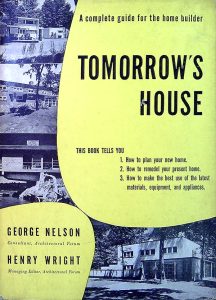
In 1937 Niccolls Wright was hired as technical editor at Architectural Forum and became a managing editor in 1942. Two years later he was joined by George Nelson as co-managing editor. In 1945, Wright and Nelson published a groundbreaking book, Tomorrow’s House, that radically modernized the idea of “home” in the American mind as well as the rooms, functions, and philosophies that made it up. By the end of 1946, the book had been reprinted five times, had sold 100,000 copies, and had climbed as high as sixth on the New York Times bestseller’s list. That same year, Wright was promoted to sole managing editor—with his own byline—at Architectural Forum. In 1948 he edited a highly regarded issue of the magazine on the all-encompassing theme of “measure,” which the table of contents delineated into sections on heat, atmosphere, light, sound, enclosure, aesthetics, houses, and space. He resigned from the magazine one year later due to unspecified policy differences with Henry Luce, the publisher, and I. M. Prentice, the incoming editor-in-chief.
Over the same twelve years that he was at Architectural Forum, Wright designed and built ten houses, five of which are known to be extant and all of which were innovative. In 1937, he collaborated with photographer and art director Paul Grotz to convert a dilapidated stone farmhouse in Blairstown, New Jersey, into the first passive solar home design on the East Coast of the United States. Not long after, he converted a nineteenth-century farmhouse in Bethel, Connecticut into a more modern and energy-efficient home for the book designer Robert Josephy, and built a second house (in collaboration with Richard Bennett and Caleb Hornbostel) for structural engineer James H. Hansen on Josephy’s property. In 1944, Wright (again with Bennett & Hornbostel) transformed a former country mansion in Milford, Pennsylvania, into the Ramirez Solar House, the second passive solar home to be built on the East Coast. Due to WWII material shortages, part of the plan for the Ramirez house involved scalping the entire third floor off the original structure and repurposing the materials into the new design. Of these four houses, the Grotz house was razed by the construction of Interstate I-80; the Josephy house still stands as the Blue Jay Orchards homestead; the location and status of the Hansen house remains unknown; and the Ramirez house eventually found itself in the footprint of the Delaware Water Gap Recreational Area, where it became the de facto property of the National Park Service. Architect Thomas Solon oversaw a substantial exterior and mechanical renovation in 2007, and the house became an official 501/c/3 nonprofit in 2012.
Of the other six houses built in this period, at least two are extant in Rye, New York. Having married Dorothy Chaya in 1939 and settled in Sunnyside Gardens alongside friends Anne and Myron Ehrenberg and Dorothy and Philip Sterling, all three families, plus Ezra and Helen Stoller, purchased a plot of vacant land in Rye in 1946 with the idea of building a community there. (A fifth family that was involved, listed only as “Hanson,” might have been James H. Hansen, for whom Wright had already built a house in Connecticut and who was a lifelong friend of the family). After two years of practical and financial delays, the Sterlings and Wrights moved into their Wright–designed homes at 6 and 7 Kirby Lane North in Spring of 1948. The precise status of the Ehrenberg, Stoller, and Hanson/Hansen houses at 9, 11, and 16 Kirby Lane North remains unknown, but there are standing structures at all three addresses. The sixth house from this period was designed and built in Stamford, Connecticut, in 1950 for the cartoonist Roy Doty. The house is extant and in very good condition.
Unfortunately, political trouble might have found Wright in the late 1940s, not long after the Kirby Lane North community was completed. Wright was a known Socialist, perhaps a card-carrying Communist for a time, and being either or both during the McCarthy Era could get you blacklisted. Wright’s departure from Architectural Forum appears to have been politically motivated, and his new community in Rye was dubbed “Red Hill” by locals. Further, when the home he codesigned with Paul Grotz was featured in the November 1950 issue of House Beautiful, there was no mention of Wright’s involvement. Research is ongoing, but there may never be a way to know definitively what effect the Red Scare had on Wright’s career. Suffice to say that while he designed and built ten extraordinary houses between 1937 and 1950, he didn’t build another house for twenty-nine years.1
Wright’s professional response in the 1950s was to pivot into private entrepreneurship, corporate consulting, and gun-for-hire editorial work. Examples of his Thru-Vu vertical blinds, a window treatment venture begun in 1949, were featured in MoMA’s famous Good Design exhibition in 1951 and remained in the museum’s 53rd Street windows long after the show had closed. Marcel Breuer and the Kremlin (!) were both Thru-Vu customers. Building on his solar energy credentials, Wright worked as an environmental control consultant for the Texas-based (and educational design focused) architecture firm Caudill Rowley & Scott. He designed an Air Conditioning Concept House for the Chrysler Corporation. Wright was also the Environmental Control Editor for House Beautiful from 1954–58 and edited a special issue on lighting for Progressive Architecture in 1958.
Wright’s technical know-how led to teaching gigs at Pratt (1958), Yale (1959) and ultimately Columbia (1961), where he was appointed an Associate Professor eligible for tenure in 1962. Alas, the Dean of Architecture who hired him was a lightning rod and, by the Spring of 1964, Wright apparently had to find a way out. After a semester at Cornell University he landed in Manhattan, Kansas, as the Regent’s Distinguished Professor of Environmental Technology at Kansas State University. He built his second heliodon there and further established himself as an expert in solar energy, lighting, and environmental control. In 1971 he was appointed a Full Professor at the City College of New York, where he taught until his retirement in 1975.
As an academic, Wright became renowned for his professional research and activism. In 1962 he authored an open letter on behalf of architects in response to the Cuban Missile Crisis. In 1963 he co-organized a nationwide University Architecture School Faculty Conference with Burnham Kelly, then Dean of the School of Architecture at Cornell. In 1964 he delivered a lecture at the annual meeting of the American Society of Mechanical Engineers titled, “The Sealed Building: ‘Ideal Environment’ or Monstrous Mistake?” that critiqued the stifling atmosphere of modern skyscrapers and was a cause célèbre in The New York Times and The New Yorker. In 1966 he delivered a follow-up lecture at a Toronto conference that was later published as “Environmental Technology as Design Determinant,” and completed the trilogy, so to speak, with a lecture titled “The Many Facets of Comfort” for the Dimension ‘67 Seminar for Architects and Consulting Engineers in Seattle. That same year, Wright built his second heliodon at the Kansas State University School of Architecture, this one equipped with spotlights delineating the sun’s path and angle at hourly intervals of the summer solstice, winter solstice, vernal equinox, and autumnal equinox. The heliodon’s interior was large enough to seat thirty-seven students and had a centrally positioned, axially adjustable table on which architectural models could be placed and their solar consequences studied at any hypothetical latitude in the world.
Wright closed out this impressive run in 1969 by instigating a special issue of Architectural Forum dedicated to the 60th anniversary of Frank Lloyd Wright’s Unity Temple. Wright and Edgar Kaufman, Jr. wrote the main essays, with Paul Grotz, who had succeeded Wright as managing editor at Architectural Forum, serving as art director.
Sometime during these years Wright’s work came to the attention of Cliff May, the celebrated West Coast architect and unofficial “inventor” of the ranch house. Wright first began advising May on climate control for his Benjamin Thaw House (1964) in West Hartford, Connecticut, and continued in that capacity for the Fletcher Jones House (1965) in Holmby Hills, California, the Hastings Harcourt House (1967) in Solvang, and the Harry Daniel House (1971) in Borrego Springs. The fact that all three latter houses were built in the California desert made solar orientation and environmental control a critical aspect of their designs. Wright advised May on all of them, both in-person and in lengthy, highly detailed letters, carbon copies of which remain in Wright’s personal papers.
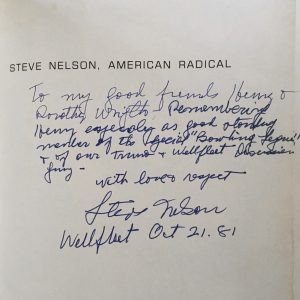
Wright’s final architectural design was for he and wife Dorothy’s retirement residence at 55 Mill Hill Road in Wellfleet, Massachusetts (1977). The house is extant and in good shape but is substantially different from recently discovered drawings that are simply labeled Cape Cod Solar House. The drawings aren’t dated but they were found in a ring binder with relevant correspondence dated 1974, so it seems safe to say that the drawings are concurrent. Had it been built as drawn, the Cape Cod Solar House would have been the most radical design of Wright’s career. Never seen or published, the drawings delineate a different house in concept and function from all of Wright’s previous designs. Whereas the Grotz, Ramirez, Hansen, and Rye houses featured southern facades comprised of large glass curtain walls capped with prominent roof overhangs, the Cape Cod Solar House proposed an angled, three-storey southern façade consisting entirely of opaque solar panels. Presumably the panels would have heated the interior in winter and shaded it in summer, while large eastern- and western-facing window wells would have admitted direct sunlight in the morning and late afternoon but only ambient light at midday. This approach marks a significant change in Wright’s thinking about how best to utilize solar orientation, light, and heat. For whatever reasons, most likely financial, the Cape Cod Solar House wasn’t built. It’s fortunate that the drawings still exist.
A renovation of 55 Mill Hill Road, the house that was ultimately built, is imminent, aided in some respects by the Cape Cod Solar House drawings but much more by Wright’s meticulous recordkeeping. A trove of receipts and canceled checks will make it possible to reconstruct a detailed timeline of the house’s construction, from closing on the vacant lot in February 1977 to the last electrician’s bill in January 1978. A similar cache of snapshots has been found chronicling the demolition and renovation of the entire ground floor of the house, necessitated by a burst pipe in the winter of 1994. The freeze was catastrophic for the house’s radiant heating system, but key details about original floor coverings can be gleaned from the images. And while the built structure’s original drawings haven’t been located (a formal request has been submitted to the Wellfleet Buildings Department), drawings of the house do exist thanks to a small addition made in 1981 that required a zoning variance. The drawings that were submitted for approval would appear to have been made directly from the originals.
Henry Niccolls Wright died of a heart attack at Cape Cod Hospital in Hyannis on Friday, October 3, 1986.
Note
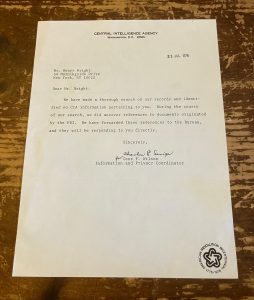
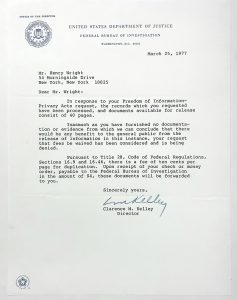
1. In November 1974 Congress passed The Privacy Act, an amendment to the Freedom of Information Act that granted private citizens the right to request information from the federal government. Within months of its passage, Henry Wright wrote the Central Intelligence Agency requesting whatever information they had on him. The CIA replied that they had nothing on him, but they had taken the liberty of forwarding his request to the Federal Bureau of Investigation, who said they did. In Spring of 1975, the FBI offered to send Wright forty pages of documents pertaining to him, provided he was willing to pay the processing fee of ten cents per page. There is no record of whether he agreed to pay or if he ever received the documents. A new FOIPA request pertaining to Henry Niccolls Wright was submitted in May 2024. The FBI responded that they could not find any relevant material on Wright and, given the age of the documents in question, they had likely been destroyed. The FBI couldn’t confirm, however, that the documents had been destroyed, nor, they said, could their response be construed as confirmation that any such documents ever existed.
Anecdotally, Wright’s youngest son Tom believes that his father was a member of the Communist Party until 1965, when he likely was required to sign a loyalty oath in order to be appointed at Kansas State University.
Private Sources
Henry and Dorothy Wright papers, Wellfleet, MA
Email exchanges with sons Tom, Richard, and John Wright, John’s wife Ellen, and Christina Wright, the daughter of eldest son William, deceased
Caleb Hornbostel papers, Norwich, VT
Malcolm Mehldahl, Deep River, CT
Public Sources
Architectural Forum digital archive, https://usmodernist.org/index-af.htm.
Barber, Daniel. A House in the Sun: Modern Architecture and Solar Energy in the Cold War. Oxford: Oxford University Press, 2016.
___. “Tomorrow’s House: Solar Housing in 1940s America,” Technology and Culture Vol. 55, No. 1 (January 2014): 1-39.
The Federal Bureau of Investigation, Washington DC.
Gottscho-Schleisner Collection, The Library of Congress. The Gottscho-Schleisner collection provides a detailed look at architectural styles and trends throughout the United States. It ranges from 1896–1970, with the bulk of the material from 1935–1955.
Jacobs, James A. “Social and Spatial Change in the Postwar Family Room,” Perspectives in Vernacular Architecture Vol. 13, No. 1 (2006): 70-85.
Jamroz, Jessica. Architectural consultant on the Ramirez Solar House restoration http://www.jessicajamroz.com/work/ramirez-solar-house–historic-us-solar-house-cultural-landscape/
Josephy, Robert. Taking Part: A Twentieth Century Life. Iowa City: The University of Iowa Press, 1993.
Kendig, Joanna. “Ramirez solar house: a case study of early solar design,” Master of Science in Architectural Studies thesis. Newark: New Jersey Institute of Technology, 2001.
Henry R. Luce Papers, NYU Special Collections, Patricia D. Klingenstein Library, New York Historical Society.
MIT Solar House Project. https://web.mit.edu/nature/archive/student_projects/2007/rsr/index.html
Nelson, George and Henry N. Wright. Tomorrow’s House. New York: Simon & Schuster, 1945.
“Talk of the Town,” The New Yorker (December 12, 1964).
Progressive Architecture digital archive, https://usmodernist.org/index-pa.htm.
Roesler, Sascha. City, Climate, and Architecture: A Theory of Collective Practice. Basel: Bürkhauser, 2022.
Solon, Thomas, “Rehabilitation of Henry Wright’s Ramirez Solar House,” AIA Architect (vol. 15, 7 March 2008) https://info.aia.org/aiarchitect/thisweek08/0307/0307s_solar.htm
Sterling, Dorothy. Close to My Heart: An Autobiography. 2005.
Wright, Henry. Personal papers, Cornell University Library, Division of Rare and Manuscript Collections, https://rmc.library.cornell.edu/EAD/htmldocs/RMM02736.html#a1.
Wright, Henry Niccolls. digital archive, http://solarhousehistory.com/resources.