Store A

CATALYST Acrylic Tears
Wear CATALYST any time
you want to give the appearance of having feelings
or need to alter the chemistry of your surroundings.
Waterproof, media-proof, nonhypoallergenic.
Apply CATALYST to the skin with eyelash adhesive
or any other clear-drying, clinically tested cosmetic glue.
Contains Nonyl Phenol, polyoxyalkyleneamines,
N-Aminoethylpiperazine, Bisphenol A, epichlorohydrin resin,
aliphatic and aromatic glycidyl ethers.
First published on the package design for Catalyst brand acrylic tears, 1999.
Paris
Bruges
Villeurbanne


Octopus and Do It Yourself / Dead on Arrival / Pay for Your Pleasure (reprise)
FOR IMMEDIATE RELEASE: June 21, 2002
STORE A OPENS TWO NEW OUTLETS IN BELGIUM AND FRANCE
Store A is pleased to announce the opening of two new outlets on the European continent. The first is located in Bruges, Belgium, and the second is in Villeurbanne, France. Both stores represent the first phase of Store A’s strong entry into the European marketplace. Given the record U.S. trade deficit and the recent weakness of the dollar against the euro, the move couldn’t be timed more perfectly.
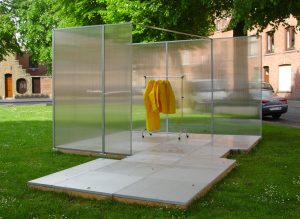
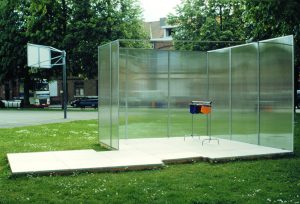
The 13-square-meter store in Bruges, Belgium, financed in part by the city’s ministry of culture, is located in the Werfplein, a working class neighborhood along the northern arc of the city’s central district. The store will specialize in seasonal accessories and apparel. According to Donelle Woolford, Chief Information Officer for European ventures, the store’s premiere offering of classic hooded yellow rubber raincoats was an unqualified success. “People are responding very positively to the raincoats,” said Woolford. “Because, if it’s raining—which it often is in Belgium—you can get a raincoat. And if it’s not raining, you’re so happy it’s not raining that the sight of something as momentarily useless as a yellow rubber raincoat is quite pleasing. So it’s really a win/win situation.”
The Bruges store is also a technical marvel, having been completely constructed from Macroform plastic, a German product noted for its structural integrity, its shimmering translucency, and its light weight. In fact, the Werfplein store is designed as a portable structure, capable of breaking down and relocating at a moment’s notice to take full advantage of any retail opportunity that might present itself, wherever that opportunity may be.
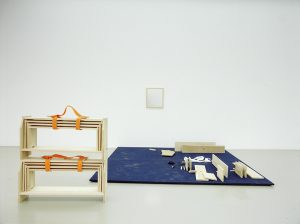
In Villeurbanne, a suburb of Lyon noted for its museums and restaurants, Store A has opened a 9-square-meter Do-It-Yourself Annex in the project gallery of the Institute d’Arte Contemporain. The DIY Annex Villeurbanne is devoted exclusively to the DIY coffin, an assisted Readymade conceived by Chief Product Designer Joe Scanlan that is the result of subtle alterations to standard IKEA components. The DIY Annex affords customers a hands-on opportunity to test drive the DIY coffin, either by assembling the product from scratch or by reclining in a recently completed model. Says Scanlan, “The French are notoriously self sufficient and self examining, so the DIY Annex appeals to them greatly. They seem to enjoy the self determination that the Annex allows, and yet they also seem to appreciate the existential dilemma that assembling one’s own coffin presents. Given the recent gains of Jean-Marie LePen and the premature defeat of the French football team in the World Cup, ‘digging your own grave’ is a concept very much in the forefront of the nation’s collective conscience.”
For images or more information on the Bruges and Villeurbanne stores, or for news regarding an upcoming store near you, contact Donelle Woolford at donellew@earthlink.net.
Press release for two concurrent exhibitions: Octopus, a city-wide group exhibition in Bruges, Belgium, and Do It Yourself Dead On Arrival Pay For Your Pleasure (reprise), a one-person exhibition at the Institut d’Art Contemporain, Villeurbanne, France, 2002.
Antwerp
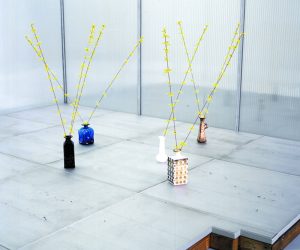
Vienna
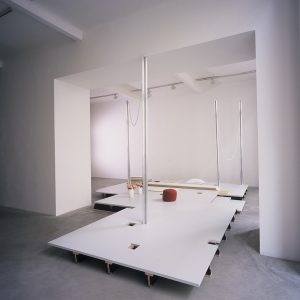
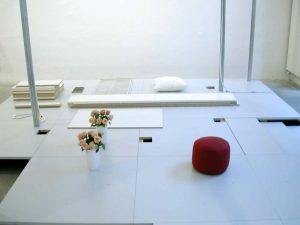
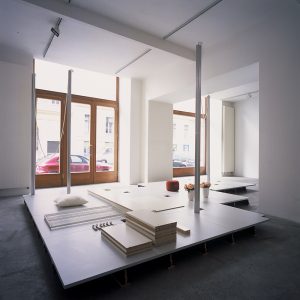
Miesian Gymnasium
Raum Aktueller Kunst Martin Janda, Vienna
FOR IMMEDIATE RELEASE: October 24, 2003
CONTACT: Donelle Woolford, storea@earthlink.net
“Miesian Gymnasium” opens in Vienna
New boutique offers vigorous ideological workout
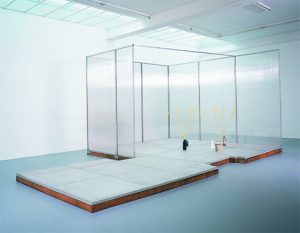
Store A is pleased to announce the opening of its newest store on the European continent in Vienna, Austria. The 14.5 square meter store is located at number 11 Eschenbachgasse in the heart of the city’s museum campus, steps away from the Kunsthistorisches Museum, the Kunsthalle Wien, the Museum of Modern Art, and the Wiener Secession.
In keeping with Vienna’s affection for pious architects—from Rudolph Schindler and Adolph Loos to Richard Neutra and Hans Hollein—the Miesian Gymnasium offers for consideration the elegant formal principles of Ludwig Mies van der Rohe, the German architect who turned the local complaints of Adolf Loos and Rudolf Schindler into a monumental international aesthetic.
There is no doubt that Mies van der Rohe’s ideology—which is visible in everything from war memorials to box store displays—has had a lasting impact on our culture. The question getting a workout in the Miesian Gymnasium, however, is whether Mies van der Rohe’s relevance today is based on his formal principles or on the ruthless economy of means those principles have inspired. For all his exquisite proportions, material fetishes, technical innovations and attention to detail, it could be argued that Miesian austerity lives on today not because it is beautiful but because it is profitable.
Miesian Gymnasium adheres to this argument. However much Mies might be spinning in his grave over all the buildings designed according to the size of a sheet of plywood multiplied in every direction, we cannot deny that his rejection of ornament and his commitment to rectilinearity has been transformed by the likes of IKEA and Home Depot into a rationale for making everything as similar and interchangeable as possible. Not because that approach to design is philosophically interesting, nor because it is a technical marvel, but because it is the cheapest way to make as many things as possible.
In this spirit, the Vienna store has been constructed entirely of modular units drawn in autocad and milled into identical parts by a digital CNC machine. Once drawn—and once proven to be interchangeable—Miesian Gymnasiums such as this can be built and shipped the world over, with no variation or loss of quality. Inversely, there can be no variation or gain in quality, either. That, it would seem, is the price of efficiency, however egalitarian it may be.
For pictures of the Miesian Gymnasium, or for news regarding a possible store near you, contact Donelle Woolford at storea@earthlink.net.
Press release for Mieses to Pieces, an exhibition at Raum Aktueller Kunst Martin Janda, Vienna, September 2003
4166 Sea View Lane: A Reader
96 pages, 8 color illustrations, perfect-bound in a 4-color cardstock sleeve


For Immediate Release: July 1, 2003
Contact: Donelle Woolford, storea@earthlink.net
$12.00
Commerce Publishing is pleased to announce issue 4 in its ongoing series of books devoted to economically motivated works of art. This issue is devoted exclusively to 4166 Sea View Lane, the already infamous sculpture designed and built in 1998 by American artist Jorge Pardo (b. 1963, Havana, Cuba) under the auspices of the Museum of Contemporary Art Los Angeles.
Remember Jorge’s house? Remember all the gossip and hubris that surrounded its premiere, its financing, its completion? Five years have passed since it opened as a public sculpture and private residence. And although five years is not enough time to determine its status as a house or a work of art, now seems like a particularly plangent moment to check in on 4166 Sea View Lane, “the house that is also a sculpture,” and see how all the proclamations and jealousies sound after having been filtered through public opinion.
To mark the fifth anniversary of its public unveiling, COMMERCE 4 presents, for the first time and in one volume, every known piece of published writing in which the house-cum-sculpture was mentioned, from three-sentence calendar listings in The Los Angeles Times to full-blown critical exegeses gleaned from obscure theoretical journals—thirty-six articles in all—including ten translated from the German and made available for the first time in English in this volume. Contributors include: Paola Antonelli, design curator at the Museum of Modern Art, New York; Kurt Finsten, director of the Krabbesholm Hojkskole, Skive, Denmark; Michelle Grabner, a suburban housewife in Oak Park, Illinois; Miwon Kwon an art historian at UCLA; and Joel Sanders, an architecture theoretician at Yale University.
Here at COMMERCE, few articles of faith are held more dearly than voluntary word of mouth. Consequently, what first inspired us to devote an issue to 4166 Sea View Lane was the incredible amount of conversation the project generated. This issue is not intended as the last word on 4166 Sea View Lane but as a thorough compilation of where the discussion left off. Nor is it an attempt to return to the golden age of irrational exuberance and aesthetic trivia that was 1998. Instead, it represents a desire to look again with fresh eyes at an extraordinary object that got made and reconsider what was written and said about it. As such, it affords a rare opportunity to reassess an artwork just as it is beginning to fade from public view. Rather than prudently wait another ten or twenty years to see where Jorge’s house stands in the annals of late twentieth-century art and design, it is more interesting to revisit it now, in what should be its awkward formative years, and measure today’s opinions alongside those generated at its inception.
For review copies of COMMERCE 4, 4166 Sea View Lane: A Reader, or to place an order, contact Donelle Woolford at storea@earthlink.net. Commerce Publishing is a subsidiary of Store A.
Paris (again)

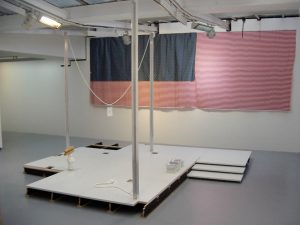
BUY AMERICAN
Galerie Chez Valentin, Paris
February 7 – March 6, 2004
Walead Beshty
Louis Cameron
Jay Chung
Martha Friedman
James Hyde
Hirsch Perlman
Joe Scanlan
Donelle Woolford
For Immediate Release: January 15, 2004
Contact: Joe Scanlan, 203-645-7154, storea@earthlink.net
Store A opens BUY AMERICAN boutique in Paris
Exclusively devoted to products from the U.S.A.
Store A is pleased to announce the opening of its latest venture in Europe, an 11-square meter store at 9 rue Saint-Gilles, Paris, in the 3rd arondissement.
The BUY AMERICAN boutique is in the business of promoting alternative ideas of what it means to be an American. Not the kind of American we have come to loathe in the past few years, but the thoughtful, doubtful, introspective kind of American who has been muscled temporarily from public view. The BUY AMERICAN boutique is about persons who—however small or isolated their enterprises—still believe they have agency.
Commentators are lately fond of saying that America has become a Hobbesian state, in reference to British philosopher Thomas Hobbes who, in his signature work, Leviathan, proposed that war is the natural condition of man. In some respects this observation is true. Two decades of corporate and governmental animosity has created an atmosphere of perpetual contestation: against the world, against each other, against the driver in the next lane. Being competitive at all times toward every person you encounter has become the preferred mode of behavior. If you are not preemptively trying to get ahead of others, then they are probably getting ahead of you.
In such an aggressive state of mind, knowledge becomes a hindrance. No person can claim to be truly knowledgeable without admitting that their knowledge has limits, is subject to doubt, and is therefore vulnerable to attack. The more sophisticated the knowledge, the more vulnerable it is. Knowledge is weakness. On the other hand, any person who claims to be faithful suffers neither limits nor doubts. Their willful ignorance in the face of overwhelming opinion or scientific fact only serves to strengthen their faith. The more blind the faith, the more powerful it is. Faith is power.
Under the leadership of our current president, traits that should be the basis of human knowledge–curiosity, skepticism, reason, humility–are portrayed as signs of weakness because they demonstrate a lack of faith. To be reasonable or skeptical is to be an unbeliever, and not believing is the work of traitors and evildoers. Consequently, the United States has devolved into a Darwinian society whose only salvation is faith in God, a Swiftian paradox that would be extremely funny were it not so disingenuous and hostile.
By contrast, the BUY AMERICAN boutique features goods that are underwhelming and nonthreatening. Goods that are full of pointless systems, trivial obsessions and petty scams. Goods that are laughable and poetic. Goods that refuse to be competitive. But these goods can’t be dismissed, because they represent everything that America is not. In that sense, the BUY AMERICAN store is an act of appropriation, an attempt to leverage hatred for this moment in American belligerence by transforming it into love for its dissenters.
Yes! It’s reassuring to know there are still people who refuse to comply. Yes! It’s comforting to know there are people who refuse to be bellicose and mercenary and dull. Yes! It’s encouraging to know there are people whose products are thoughtful. Yes! It’s consoling to know they are there and they need our financial support. Yes! BUY AMERICAN. Yes.
Press release for BUY AMERICAN, a group exhibition curated for Galerie Chez Valentin, Paris.
Wellfleet

Villeurbanne (again)
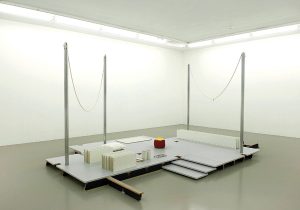
Store A was founded in Brooklyn in 1999 as a loose collaboration of artists, writers and scholars devoted to fostering knowledge and appreciation for economically motivated works of art. It dissolved operations in 2007.